Mind map of Essay plan: should social media have an age limit?
Pasted text · 33 nodes
What you add
Essay plan: should social media have an age limit?
Pasted text
382 words becomes 33 nodes
Essay planning notes written for this example
Interactive mind map
 Loading the interactive mind map…
Drag to move, click a node to fold it.
Summary
This essay plan argues that social media platforms should keep users under 16 off their services. It starts from the gap between the rule and practice: most platforms set 13 as the minimum because of the US COPPA law of 1998, but age checks usually mean typing in a birth date. Three arguments follow. Early adolescence is a sensitive period, and the US Surgeon General's 2023 advisory said there was not enough evidence that social media is safe for young people, though much research shows correlation rather than causation. Features such as infinite scroll and autoplay are built to capture attention that younger teenagers find harder to resist. And an unenforced limit protects no one. The plan answers the counterargument about community, privacy and workarounds, and concludes that the cautious choice is to protect younger teenagers, citing Australia's 2024 law setting a minimum age of 16.
Key takeaways
- Thesis: platforms should be required to keep users under 16 off their services.
- The current limit of 13 comes from COPPA (1998) and is barely enforced.
- Evidence: the US Surgeon General's 2023 advisory, with a caution about correlation.
- The counterargument covers community for isolated teens, privacy and workarounds.
- Australia passed a minimum-age-16 law in November 2024.
All 33 nodes
The full mind map as an outline.
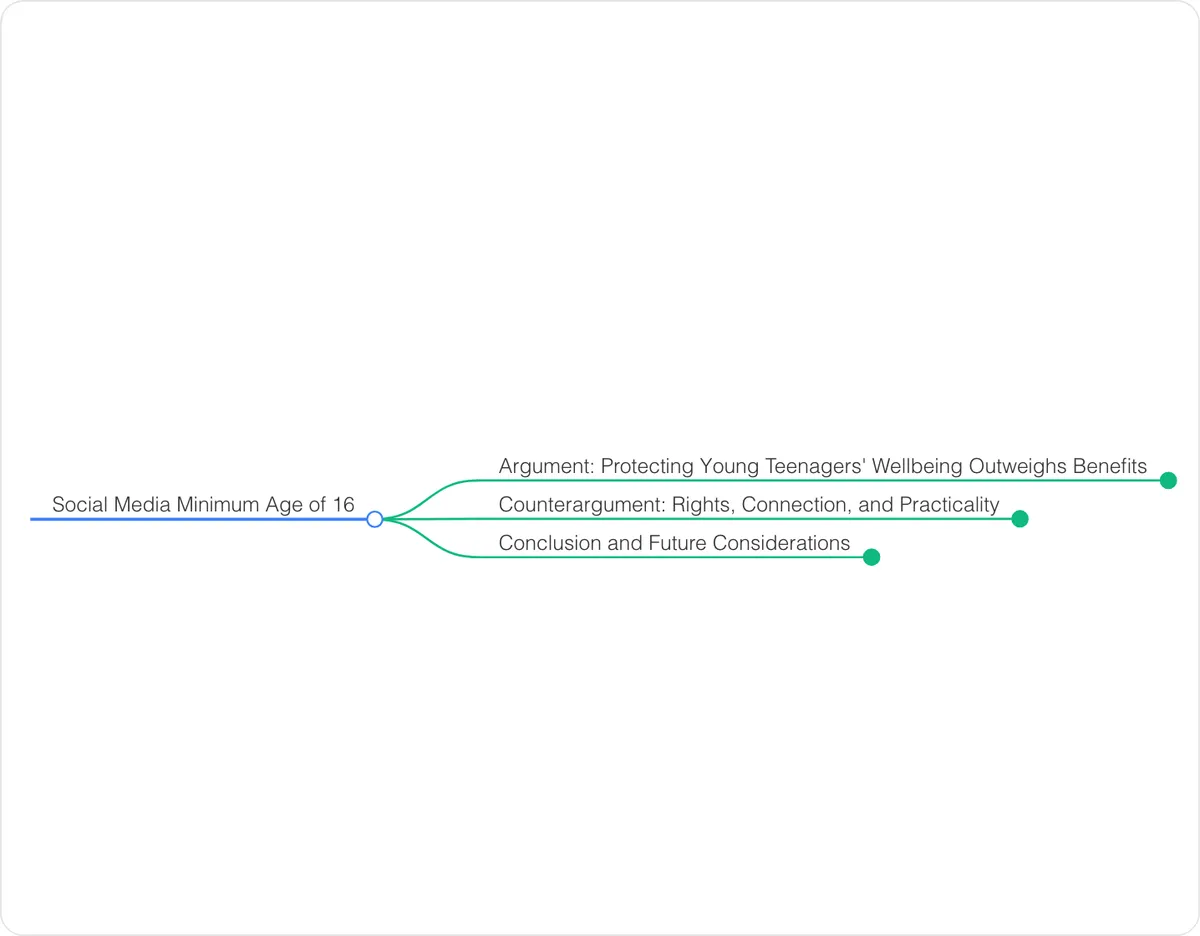
Social Media Minimum Age of 16
- Argument: Protecting Young Teenagers' Wellbeing Outweighs Benefits
- Risks to Wellbeing
- Sensitive Development Period: Early adolescence is critical for brain development and self-image formation.
- Mental Health Concerns:
- US Surgeon General's advisory (May 2023) highlighted insufficient evidence of safety for young people.
- Studies link heavy social media use with poor sleep and anxiety.
- Caution: Much research shows correlation, not causation.
- Platform Design Targeting Attention
- Addictive Features: Infinite scroll, autoplay, and notifications are designed to maximize user engagement.
- Vulnerability of Younger Users: Teenagers have less developed self-control to resist these attention-grabbing features.
- Failure of Current Age Limit
- Minimum Age of 13: Most platforms use 13 as the minimum, largely due to the US Children's Online Privacy Protection Act (COPPA, 1998) which restricts data collection from children under 13.
- Lack of Enforcement:
- Age checks typically involve simple birth date entry, allowing many younger children to create accounts.
- A rule without enforcement offers no real protection.
- Need for Legal Duty: A legal requirement on platforms would necessitate robust age verification methods.
- Risks to Wellbeing
- Counterargument: Rights, Connection, and Practicality
- Benefits of Social Media
- Community Building: Social media helps isolated teenagers find communities, including support for LGBTQ+ youth.
- Connection: Facilitates social interaction and information access.
- Challenges with Age Verification
- Privacy Concerns: Requiring ID uploads for age verification can pose significant privacy risks.
- Circumvention: Determined teenagers are likely to find ways to bypass age restrictions.
- Rebuttals to Counterarguments
- Alternative Access: A ban on accounts doesn't prevent messaging or supervised use.
- Privacy-Preserving Technology: Existence of age verification methods that protect privacy.
- Default Changes: Laws can change platform defaults, even if some users circumvent them.
- Benefits of Social Media
- Conclusion and Future Considerations
- Restate Thesis: Social media platforms should be required to keep users under 16 off their services.
- Acknowledging Evolving Evidence: The body of research on social media's impact is still developing.
- Precautionary Principle: The cautious approach is to protect younger teenagers while further research is conducted.
- Recent Legislation: Australia passed a law in November 2024 setting a minimum age of 16 for social media accounts, indicating a global shift in regulatory approaches.