Mind map of On the Duty of Civil Disobedience
EPUB · 64 nodes
What you add
pg71-images-3.epub
EPUB
~9,400 words becomes 64 nodes
Excerpt from the original: On the Duty of Civil Disobedience
by Henry David Thoreau
1849, original title: Resistance to Civil Government
I heartily accept the motto,—“That government is best which governs
least;” and I should like to see it acted up to more rapidly and
systematically. Carried out, it finally amounts to this, which also I
On the Duty of Civil Disobedience
Henry David Thoreau, Project Gutenberg eBook #71 (public domain)
View sourceInteractive mind map
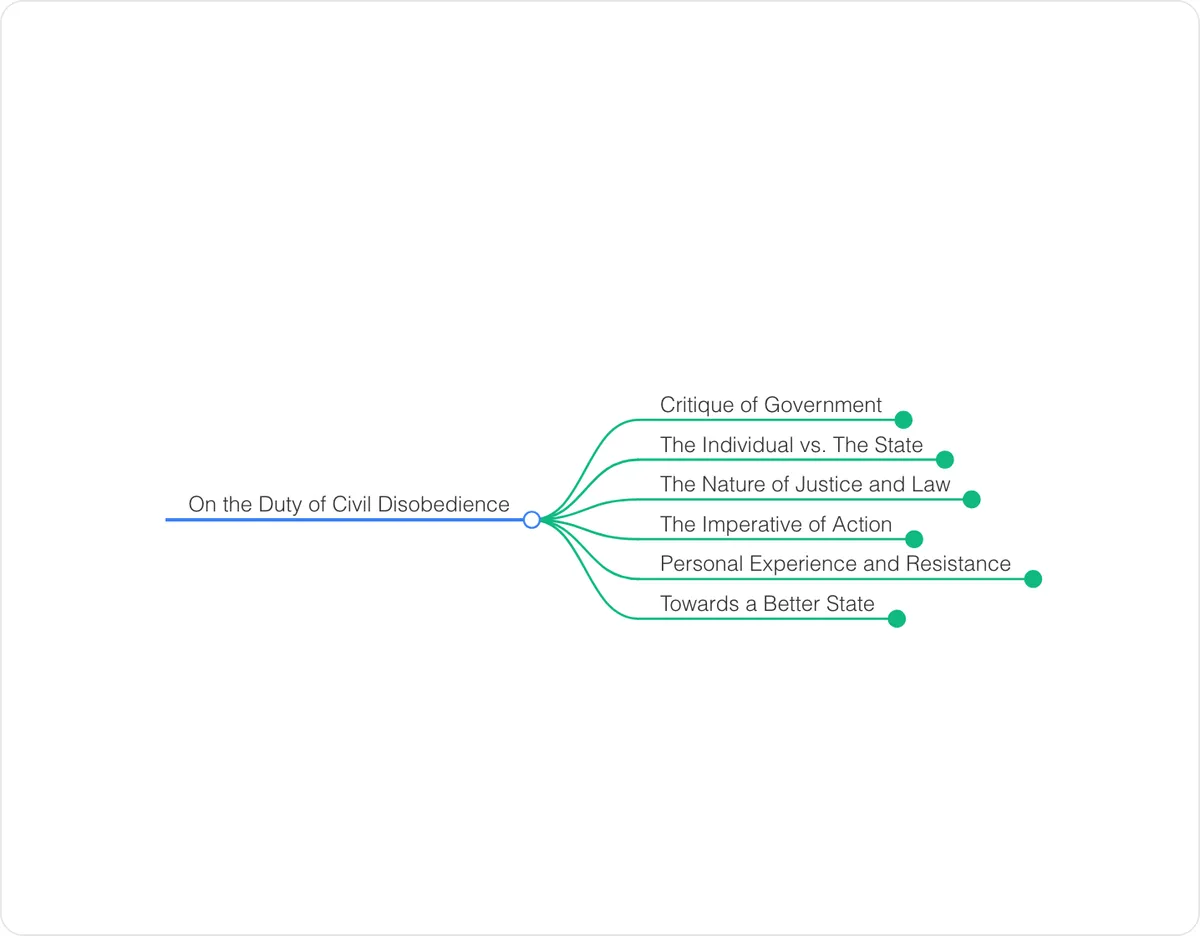 Loading the interactive mind map…
Drag to move, click a node to fold it.
Open in editorFree account
All 64 nodes
The full mind map as an outline.
On the Duty of Civil Disobedience
- Critique of Government
- Ideal government: "governs least," eventually "governs not at all"
- Government as an expedient, often inexpedient and abused
- Standing government is an arm of the standing army
- American government: a tradition, losing integrity, wooden gun
- Government hinders progress rather than furthering it
- Trade and commerce often obstructed by legislators
- The Individual vs. The State
- Demand for a better government, not no government
- Majority rule is based on physical strength, not justice
- Conscience should guide decisions, not majority rule
- Men should be men first, subjects afterward
- Respect for right is more important than respect for law
- Law does not make men just; it can make them agents of injustice
- Individuals serving the State as machines or with their heads, without conscience
- Heroes and patriots serve with conscience, often treated as enemies
- Refusal to be a mere tool or "clay"
- Association with a slave's government is a disgrace
- The Nature of Justice and Law
- Right of revolution exists when government is tyrannical or inefficient
- Present crisis: slavery and unjust war require rebellion
- Paley's principle of expediency versus doing justice at any cost
- Nations agree with Paley in practice but not always in what is right
- Merchants and farmers prioritize commerce over humanity
- Others are indifferent or merely express opinions without action
- Voting: a game with a moral tinge, not vital concern for right
- True freedom asserted through one's own vote, not majority decision
- The Imperative of Action
- Conventions and politicians are not the focus for independent men
- The "respectable" man drifts from position and despairs of country
- Need for genuine men with conviction
- Duty to withdraw support from unjust government, not wait for majority
- Action from principle is revolutionary
- Unjust laws exist: break them rather than obey or wait for amendment
- Government's fault for remedies being worse than evils
- Conscious denial of authority requires proportionate penalty
- Let your life be a counter friction to stop the machine of injustice
- Individual responsibility to not lend oneself to wrong
- Personal Experience and Resistance
- Tax-gatherer as the only direct interface with government
- Refusal to recognize the slave's government
- One honest man's withdrawal could abolish slavery
- The prison experience: a novel perspective, seeing the State's limitations
- State confronts the body, not the mind or conscience
- Imprisonment is chosen over seizure of goods for the poor
- Money corrupts, making men subservient to institutions
- Difficulty of living honestly and comfortably under unjust government
- Refusal of poll-tax leads to imprisonment
- Prison walls are a waste; true confinement is in the mind
- The State is timid and half-witted
- "My Prisons": a history of personal resistance
- Refusal to pay poll-tax is a declaration of war on the State
- Paying tax for another abets injustice
- Avoid bias from obstinacy or public opinion
- Resistance to brute force vs. human force
- Seeking excuse for conformity, but ultimately choosing higher law
- Towards a Better State
- Government's authority requires sanction and consent of the governed
- Progress towards recognizing individual rights
- Democracy is not the last improvement; seek true respect for the individual
- A State that can afford to be just, treating individuals with respect
- A State that allows individuals to live aloof, fulfilling neighborly duties
- Such a State prepares for a more perfect future State