Mind map of Classical and operant conditioning: psychology notes
Pasted text · 48 nodes
What you add
Classical and operant conditioning: psychology notes
Pasted text
384 words becomes 48 nodes
Psychology notes written for this example
Interactive mind map
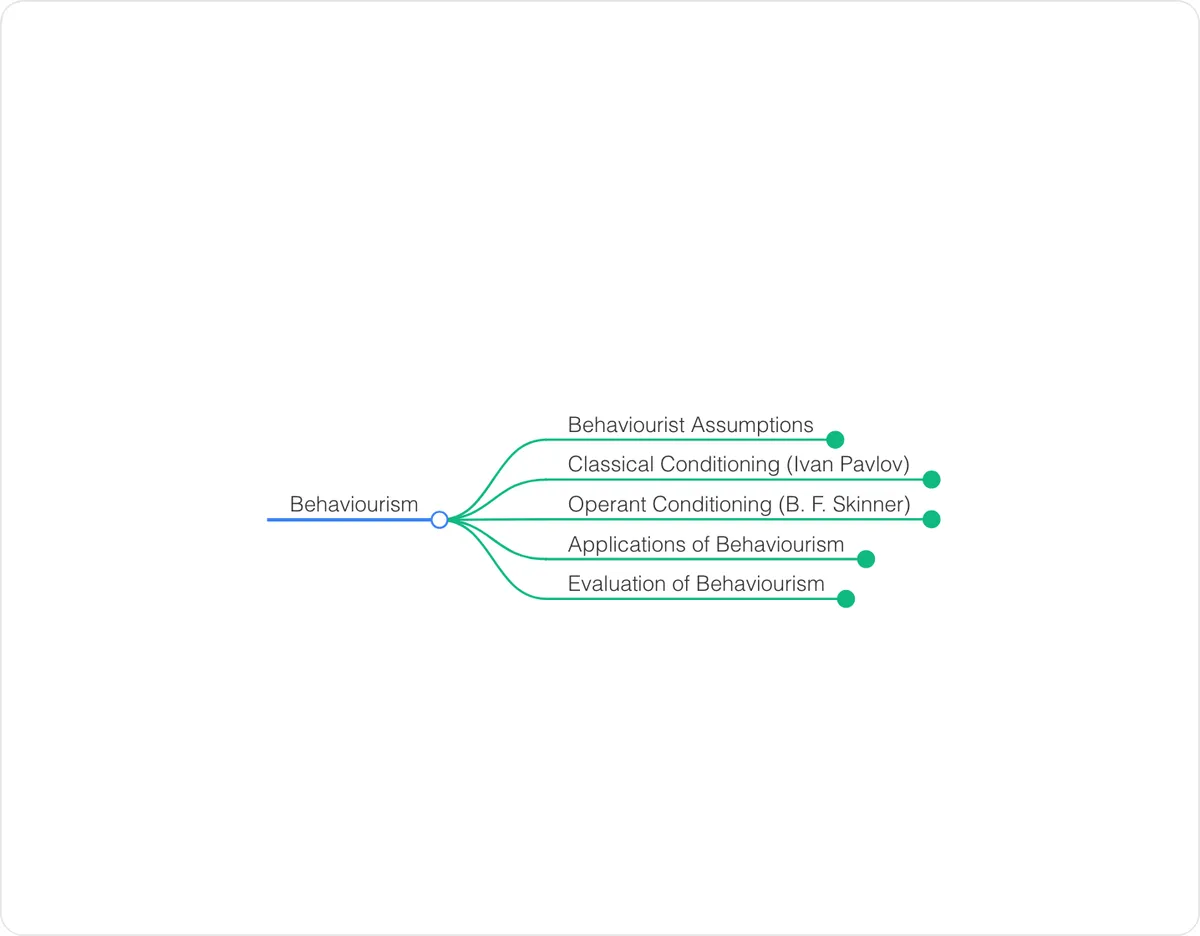 Loading the interactive mind map…
Drag to move, click a node to fold it.
Summary
These psychology notes cover the two behaviourist theories of learning. Behaviourists assume behaviour is learned from the environment, study only what can be observed, and apply the same laws to animals and humans. In classical conditioning, Pavlov showed that a bell paired with food comes to trigger salivation on its own, with extinction, spontaneous recovery, generalisation and discrimination as follow-on effects; Watson and Rayner's Little Albert study conditioned fear of a white rat and raised serious ethical problems. In operant conditioning, Skinner built on Thorndike's law of effect: positive and negative reinforcement make behaviour more likely, punishment makes it less likely, and variable-ratio schedules, as in gambling, are the hardest to extinguish. The notes end with applications such as systematic desensitisation and token economies, and an evaluation that includes Bandura's social learning theory.
Key takeaways
- Behaviourists study only observable behaviour and treat animal and human learning as alike.
- Classical conditioning: a neutral stimulus paired with food comes to trigger the response on its own.
- Operant conditioning: reinforcement makes a behaviour more likely, punishment less likely.
- Variable-ratio reinforcement, as in gambling, is the most resistant to extinction.
- Critics say behaviourism ignores thinking; Bandura added learning by observation.
All 48 nodes
The full mind map as an outline.
Behaviourism
- Behaviourist Assumptions
- Behaviour is learned from the environment, not inborn.
- Scientific study should focus solely on observable behaviour.
- The same learning laws apply to animals and humans, justifying animal experiments.
- Classical Conditioning (Ivan Pavlov)
- Definition: Learning through association between two stimuli.
- Pavlov's Observation: Dogs salivated before receiving food.
- Stages of Conditioning:
- Before: Food (UCS) -> Salivation (UCR); Bell (NS)
- During: Bell repeatedly paired with Food.
- After: Bell (CS) -> Salivation (CR)
- Extinction: The CR fades when the CS appears without the UCS.
- Spontaneous Recovery: The extinguished response briefly reappears after a rest.
- Generalisation: Similar stimuli elicit the CR.
- Discrimination: The animal learns to respond only to the specific CS.
- Little Albert Study (Watson & Rayner):
- 11-month-old boy conditioned to fear a white rat by pairing it with a loud noise.
- Fear generalised to other furry objects.
- Raised significant ethical concerns.
- Operant Conditioning (B. F. Skinner)
- Definition: Learning from the consequences of behaviour.
- Thorndike's Law of Effect (1898): Behaviour followed by satisfying results is likely to be repeated.
- Skinner Box: Rats learned to press a lever for food.
- Types of Consequences:
- Positive Reinforcement: Adding a pleasant stimulus increases behaviour (e.g., food, praise).
- Negative Reinforcement: Removing an unpleasant stimulus increases behaviour (e.g., stopping an electric current, relieving a headache).
- Positive Punishment: Adding an unpleasant stimulus decreases behaviour.
- Negative Punishment: Removing a pleasant stimulus decreases behaviour (e.g., phone being taken away).
- Schedules of Reinforcement:
- Fixed ratio, variable ratio, fixed interval, variable interval.
- Variable ratio (e.g., gambling) yields the highest response rate and is most resistant to extinction.
- Applications of Behaviourism
- Systematic Desensitisation: Used for treating phobias (classical conditioning).
- Token Economies: Implemented in schools and prisons (operant conditioning).
- Animal Training: Behavioural principles are applied.
- App Design: Encouraging repeated use through rewards.
- Evaluation of Behaviourism
- Strengths:
- Scientific rigour and controlled experiments.
- Development of practical and effective therapies.
- Weaknesses:
- Neglects internal cognitive processes and emotions.
- Findings from animal studies may not fully generalise to humans.
- Environmental determinism overlooks the concept of free will.
- Social Learning Theory (Bandura):
- Adds that learning also occurs through observation and imitation of others.
- Demonstrated by the Bobo doll study (1961).
- Strengths: