Mind map of Chemical bonding: chemistry notes
Pasted text · 55 nodes
What you add
Chemical bonding: chemistry notes
Pasted text
349 words becomes 55 nodes
Chemistry notes written for this example
Interactive mind map
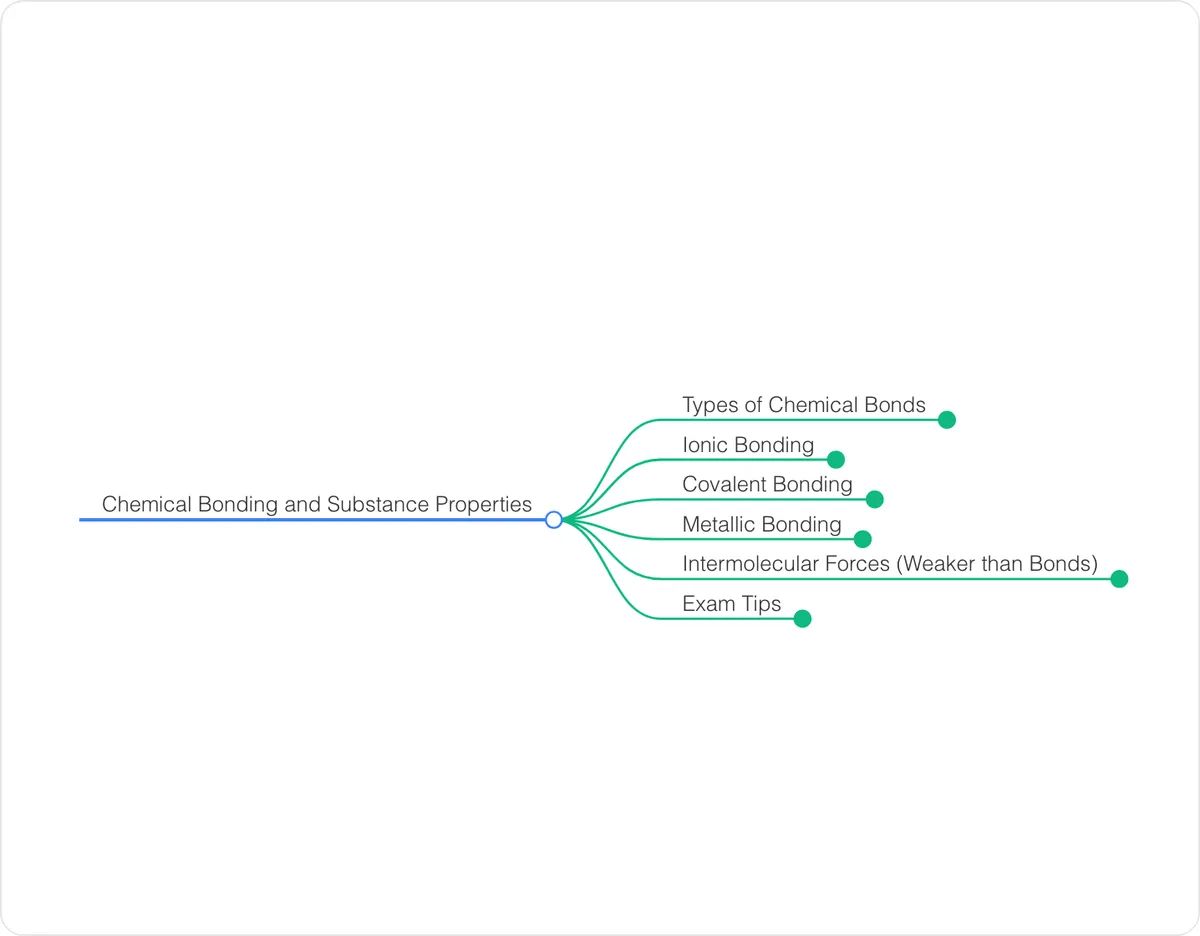 Loading the interactive mind map…
Drag to move, click a node to fold it.
Summary
These chemistry notes explain why atoms bond and how the type of bond decides a substance's properties. Atoms bond to reach a full outer shell, and the electronegativity difference between them predicts whether the bond is ionic, polar covalent or non-polar covalent. Ionic bonds form when a metal transfers electrons to a non-metal, giving giant lattices with high melting points that conduct only when molten or dissolved. Covalent bonds share electron pairs: simple molecules such as water have low melting points, while giant structures such as diamond and graphite are very different, with graphite conducting through delocalised electrons. Metallic bonding is a lattice of positive ions in a sea of delocalised electrons, which explains conductivity and malleability. The notes finish with intermolecular forces, including the hydrogen bonding behind water's high boiling point, and exam tips on explaining melting points.
Key takeaways
- Electronegativity difference predicts the bond: ionic, polar covalent or non-polar covalent.
- Ionic lattices have high melting points and conduct only when molten or dissolved.
- Simple molecules have low melting points; diamond is a very hard giant covalent structure.
- Delocalised electrons explain why graphite and metals conduct electricity.
- Hydrogen bonding explains water's high boiling point and why ice floats.
All 55 nodes
The full mind map as an outline.
Chemical Bonding and Substance Properties
- Types of Chemical Bonds
- Electron Behavior in Bonding
- Atoms bond to achieve a stable electron configuration, typically a full outer shell.
- The nature of the bond depends on electron transfer, sharing, or pooling.
- Electronegativity and Bond Type
- Electronegativity measures an atom's attraction for bonding electrons (Pauling scale, Fluorine ≈ 4.0).
- Large electronegativity difference: Ionic bond.
- Small electronegativity difference: Polar covalent bond.
- No electronegativity difference: Non-polar covalent bond.
- Electron Behavior in Bonding
- Ionic Bonding
- Mechanism and Structure
- Occurs between a metal and a non-metal.
- Metal atoms transfer electrons, forming positive ions (cations); non-metals gain electrons, forming negative ions (anions).
- Ions are held together by strong electrostatic attraction in a giant ionic lattice.
- Example: Sodium chloride (Na⁺ and Cl⁻).
- Properties of Ionic Substances
- High melting and boiling points due to strong electrostatic forces.
- Conduct electricity only when molten or dissolved, as ions must be mobile.
- Often soluble in water.
- Mechanism and Structure
- Covalent Bonding
- Mechanism and Structure
- Involves the sharing of electron pairs between non-metal atoms.
- A double bond shares two pairs of electrons (e.g., O=O).
- Types of Covalent Structures
- Simple molecular substances:
- Strong covalent bonds within molecules (e.g., H₂O, CO₂, CH₄).
- Weak intermolecular forces between molecules.
- Low melting and boiling points.
- Do not conduct electricity.
- Giant covalent structures:
- Extended networks of covalently bonded atoms.
- Diamond: Each carbon bonded to four others; very hard; non-conductive.
- Graphite: Layers of carbon bonded to three others; delocalized electrons allow conductivity; layers slide, making it soft.
- Silicon dioxide.
- Simple molecular substances:
- Mechanism and Structure
- Metallic Bonding
- Mechanism and Structure
- Positive metal ions arranged in a "sea" of delocalized electrons.
- Properties of Metallic Substances
- Conduct heat and electricity due to mobile delocalized electrons.
- Malleable and ductile as layers of ions can slide past each other.
- Usually possess high melting points.
- Mechanism and Structure
- Intermolecular Forces (Weaker than Bonds)
- Types of Intermolecular Forces
- London dispersion forces: Present in all molecules; stronger in larger molecules.
- Permanent dipole–dipole forces: Occur between polar molecules.
- Hydrogen bonding: The strongest type; occurs when hydrogen is bonded to nitrogen, oxygen, or fluorine.
- Significance of Hydrogen Bonding
- Explains water's unusually high boiling point.
- Explains why ice is less dense than liquid water.
- Types of Intermolecular Forces
- Exam Tips
- Describing Attractions
- Always specify which particles are attracted to which when explaining bonding.
- Explaining Melting Points
- Identify what needs to be overcome: ionic bonds, covalent bonds, metallic bonds, or only intermolecular forces.
- Describing Attractions