Character mind map
Paste your reading notes on a novel or play and get each character's traits, relationships, motives and arc as one map.
3 free maps without an account
Free account: 10 credits + 1 a day, no card
Up to 5,000 characters each.
A real character mind map
Generated by MindLM with the same pipeline you use, not edited by hand. Expand the nodes, or open your own copy in the editor.
What you add
Romeo and Juliet: character notes
Pasted text
586 words becomes 88 nodes
Reading notes written for this example
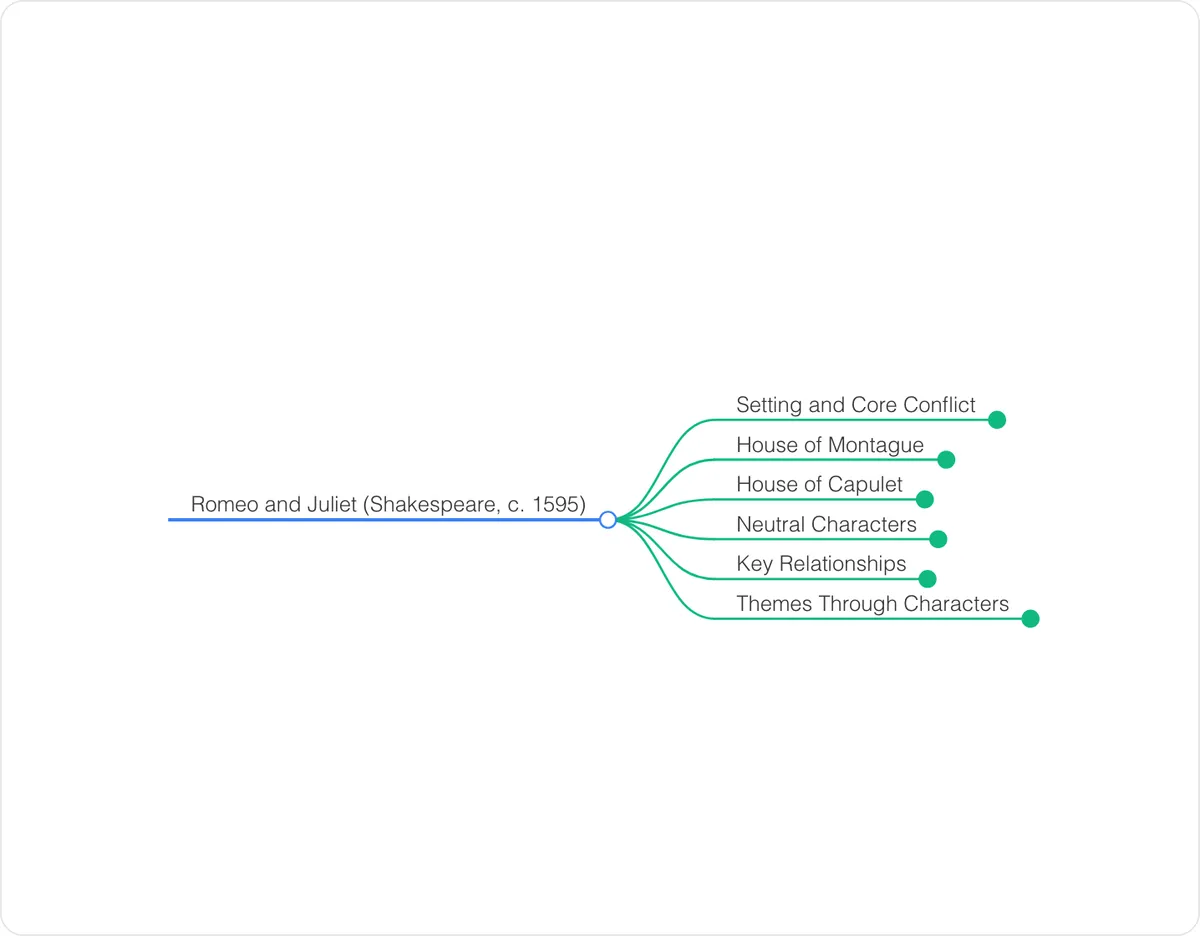 Loading the interactive mind map…
Drag to move, click a node to fold it.
Full text of this character mind map (88 nodes)
Romeo and Juliet (Shakespeare, c. 1595)
- Setting and Core Conflict
- Location: Verona, Italy
- Timeframe: Approximately four days
- Central Conflict: An ancient feud between the noble Montague and Capulet families.
- Authority's Stance: Prince Escalus has decreed death for any further disturbances of the peace.
- House of Montague
- Romeo
- Identity: Son of Lord and Lady Montague, approximately sixteen years old.
- Personality: Impulsive and driven by emotion.
- Key Actions:
- Falls instantly in love with Juliet at the Capulet feast.
- Secretly marries Juliet the following day.
- Attempts to de-escalate conflict with Tybalt.
- Kills Tybalt in revenge for Mercutio's death.
- Banished to Mantua.
- Buys poison upon hearing of Juliet's supposed death.
- Kills Paris at Juliet's tomb.
- Dies beside Juliet.
- Character Arc: Transforms from a boy infatuated with the idea of love to a husband who acts rashly.
- Lord and Lady Montague
- Role: Romeo's parents.
- Actions: Express concern over Romeo's emotional state.
- Fate: Lady Montague dies of grief following Romeo's exile.
- Benvolio
- Identity: Romeo's cousin and friend.
- Meaning of Name: "Good will".
- Role: Tries to mediate fights and maintain peace.
- Play Disappearance: Ceases to appear after Act 3.
- Romeo
- House of Capulet
- Juliet
- Identity: Only daughter of Lord and Lady Capulet, not yet fourteen.
- Personality Arc:
- Begins as obedient and sheltered.
- Exhibits the most significant growth: proposes marriage, defies her father.
- Takes Friar Laurence's potion alone despite her fear.
- Key Actions: Wakes in the tomb, finds Romeo dead, and stabs herself with his dagger.
- Character Arc: Evolves from a dutiful child to a decisive adult.
- Lord Capulet
- Initial Demeanor: Appears kind, initially advises Paris to wait.
- Later Behavior: Becomes aggressive when Juliet refuses to marry Paris, threatening to disown her.
- Action: Hastens Juliet's wedding to Paris to Thursday, precipitating the potion plan.
- Lady Capulet
- Demeanor: Cold and distant.
- Parenting Style: Delegates Juliet's upbringing to the Nurse.
- Reaction to Juliet's Plea: Turns away from Juliet when she seeks help.
- Tybalt
- Identity: Juliet's cousin, nicknamed "Prince of Cats".
- Personality: Hot-tempered, proud, harbors hatred for all Montagues.
- Motivation: Seeks to fight Romeo for attending the Capulet feast.
- Significance: Kills Mercutio, leading to his own death by Romeo, marking the play's shift from comedy to tragedy.
- The Nurse
- Relationship to Juliet: Juliet's nurse since birth, closer than her mother.
- Personality: Bawdy, talkative, and loving.
- Role: Facilitates communication between Romeo and Juliet.
- Shift in Relationship: Advises Juliet to marry Paris after Romeo's banishment, causing Juliet to lose trust.
- Juliet
- Neutral Characters
- Mercutio
- Identity: Kinsman to the Prince and Romeo's closest friend.
- Personality: Witty and mocking (e.g., Queen Mab speech).
- Key Action: Fights Tybalt when Romeo refuses, dying with a curse: "A plague o' both your houses!".
- Friar Laurence
- Identity: Franciscan friar and Romeo's advisor.
- Motivation: Marries Romeo and Juliet, hoping to reconcile the families.
- Key Actions:
- Plans the sleeping potion for Juliet.
- His crucial letter to Romeo fails to arrive.
- Flees the tomb.
- Later confesses the entire affair.
- Count Paris
- Identity: Relative of the Prince, Capulet's preferred suitor for Juliet.
- Personality: Polite and conventional.
- Fate: Killed by Romeo at Juliet's tomb.
- Prince Escalus
- Role: Ruler of Verona.
- Decision: Banishes Romeo instead of ordering his execution.
- Final Judgment: Blames both families, stating, "All are punished."
- Mercutio
- Key Relationships
- Romeo and Juliet: A secret marriage transcending the family feud.
- Romeo and Mercutio: A friendship, the loss of which drives Romeo to violence.
- Juliet and the Nurse: An initial closeness that fractures in Act 3.
- Juliet and Lord Capulet: A dynamic shifting from obedience to defiance.
- Tybalt vs. Romeo and Mercutio: Embodiment of the family feud.
- Themes Through Characters
- Love and Haste: Exemplified by Romeo and Juliet.
- Hate and Violence: Represented by Tybalt and the ongoing feud.
- Fate: The lovers are described as "star-crossed" from the Prologue.
- Adult Failure to Support Youth: Seen in the actions of Capulet, the Nurse, and Friar Laurence.
How to structure a character mind map
A good way to structure it, and a checklist to use when you edit the map yourself.
One branch per character
Main characters first, minor ones after, so the map shows at a glance who carries the story.
Traits and evidence
Each trait as a node, with the moment or quote that shows it as a leaf — the evidence an essay needs.
Relationships
Who is family, friend, rival or lover, and how each relationship drives the plot.
Motives and conflicts
What each character wants, what stands in the way, and the choices they make because of it.
Arc and themes
How the character changes from beginning to end, and which theme of the work they stand for.
When to use it
Keep track of a big cast
Paste your notes chapter by chapter and see every character and how they connect, instead of flipping back to remember who someone is.
Prepare a character analysis essay
Map one character's traits with supporting moments, then turn each branch into a paragraph with its evidence already attached.
Plan characters for your own story
Writers can paste rough character sketches and get each person's goals, conflicts and relationships laid out before drafting.
How the AI mind map generator works
Paste text or a link
Drop in an article, notes, a webpage URL or a small PDF, no account needed. Sign in to upload eBooks and larger files.
Get the map in 1–3 minutes
AI reads the content, keeps its structure and lays it out as branches you can open one at a time.
Navigate, edit, export
Collapse and expand branches, rename nodes, then export as PNG, Markdown, or XMind to use anywhere.
FAQ
Can I upload the whole novel?
Yes, after signing in you can upload an EPUB or PDF. A whole-book map tends to follow the plot, so for a character map, notes or a character list usually give a sharper result. The free trial on this page takes pasted text up to 5,000 characters.
Does it draw lines between related characters?
A MindLM map is a tree, so relationships appear as nodes under each character ("married to Tom", "rival of Tybalt") rather than as cross-links. That keeps large casts readable.
Will it make up quotes?
Quotes come from the text you paste. If you give only a book title, the AI works from general knowledge, so check any quotation against the book before you use it in an essay.
Keep exploring
More templates
Tools for this topic
Ready to map your next PDF, video, or notes?
No setup needed. Start in your browser instantly.
Encrypted storage · Your data never trains AI models · Export anytimeHow we protect your data