Mind map of Pomodoro Technique
Web page · 38 nodes
What you add
en.wikipedia.org/wiki/Pomodoro_Technique
Web page
1 web page becomes 38 nodes
Excerpt from the original: From Wikipedia, the free encyclopedia
The Pomodoro Technique is a time management method developed by Francesco Cirillo in the late 1980s.[1] It uses a kitchen timer to break work into intervals, typically 25 minutes in length, separated by short breaks. Each interval is known as a pomodoro, from the Italian word for tomato, after the tomato-shaped kitchen…
Interactive mind map
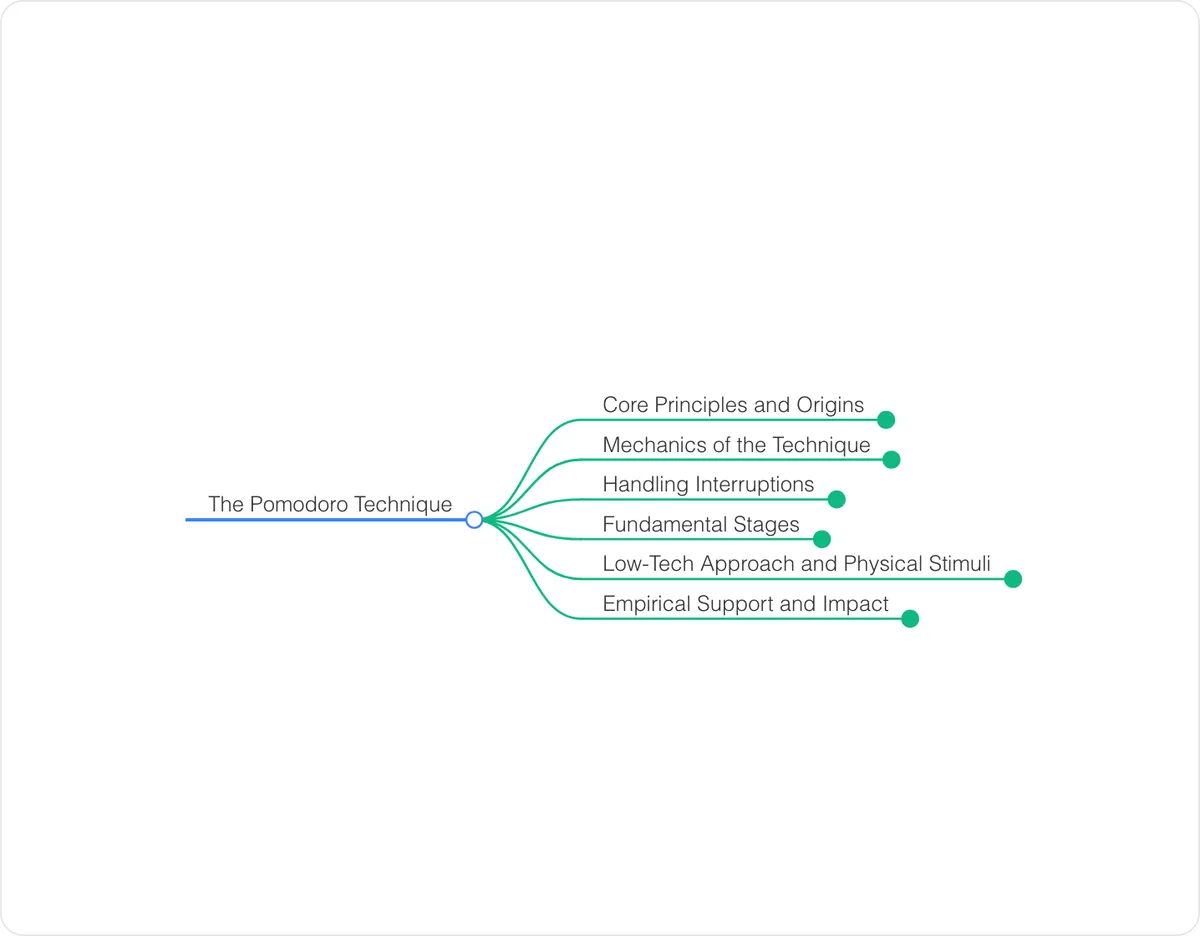 Loading the interactive mind map…
Drag to move, click a node to fold it.
Open in editorFree account
All 38 nodes
The full mind map as an outline.
The Pomodoro Technique
- Core Principles and Origins
- Developed by Francesco Cirillo in the late 1980s.
- Uses a kitchen timer to break work into intervals.
- Intervals are typically 25 minutes in length, separated by short breaks.
- Each interval is called a pomodoro (Italian for tomato).
- Popularized by apps and websites offering timers and instructions.
- Closely related to timeboxing and iterative/incremental development in software design.
- Adopted in pair programming contexts.
- Mechanics of the Technique
- Task Initiation: Decide on the task.
- Work Interval: Set the timer (typically 25 minutes) and work on the task.
- Short Break: Take a short break (typically 5-10 minutes) when the timer rings.
- Cycle Repetition: Repeat until four pomodori are completed.
- Long Break: Take a long break (typically 20-30 minutes) before starting the cycle again.
- Definition: A pomodoro is an indivisible interval of work time.
- Handling Interruptions
- Goal: Reduce the effect of internal and external interruptions on attention and flow.
- Indivisibility: A pomodoro is indivisible.
- Interruption Strategy: If interrupted, either postpone the other activity using the "inform—negotiate—schedule—call back" strategy, or abandon the pomodoro.
- Fundamental Stages
- Planning: Prioritize tasks by recording them in a "To Do Today" list.
- Tracking: Record completed Pomodori.
- Processing: Analyze work patterns and interruptions.
- Visualizing: Understand personal productivity through recorded data.
- Low-Tech Approach and Physical Stimuli
- Creator's Recommendation: Encourage a low-tech approach using a mechanical timer, paper, and pencil.
- Physical Act of Winding: Confirms determination to start the task.
- Ticking: Externalizes the desire to complete the task.
- Ringing: Announces a break.
- Association: Flow and focus become associated with these physical stimuli.
- Empirical Support and Impact
- Study on Students:
- Compared 25 students using Pomodoro against 35 taking self-regulated breaks.
- Self-regulated break groups chose longer study sessions, leading to higher fatigue and lower concentration/motivation.
- No significant difference found in mental effort or task completion between groups.
- Scoping Review (2025):
- Found that "Time-structured Pomodoro interventions consistently improved focus, reduced mental fatigue, and enhanced sustained task performance, outperforming self-paced breaks."
- Study on Students: