Mind map of Cell (biology)
Web page · 77 nodes
What you add
en.wikipedia.org/wiki/Cell_(biology)
Web page
1 web page becomes 77 nodes
Interactive mind map
 Loading the interactive mind map…
Drag to move, click a node to fold it.
Summary
Wikipedia's article on the cell describes it as the basic structural and functional unit of all life: a semipermeable membrane enclosing cytoplasm and genetic material, usually too small to see without a microscope. Robert Hooke named cells in 1665, and Schleiden and Schwann's cell theory of 1839 holds that all organisms are made of cells and all cells come from existing cells. The article then divides life into prokaryotes — bacteria and archaea, with no nucleus, a circular chromosome, a protective cell envelope and division by binary fission — and eukaryotes, which have a membrane-bound nucleus and organelles such as the endoplasmic reticulum, Golgi apparatus, mitochondria and, in plants, chloroplasts.
Key takeaways
- The cell is the basic structural and functional unit of all life.
- Cell theory (1839): all organisms are made of cells, and all cells come from existing cells.
- Prokaryotes (bacteria, archaea) lack a nucleus and divide by binary fission.
- Eukaryotes have a membrane-bound nucleus and organelles such as mitochondria and the Golgi apparatus.
- Plant cells and fungi also have a cell wall; plants add chloroplasts for photosynthesis.
All 77 nodes
The full mind map as an outline.
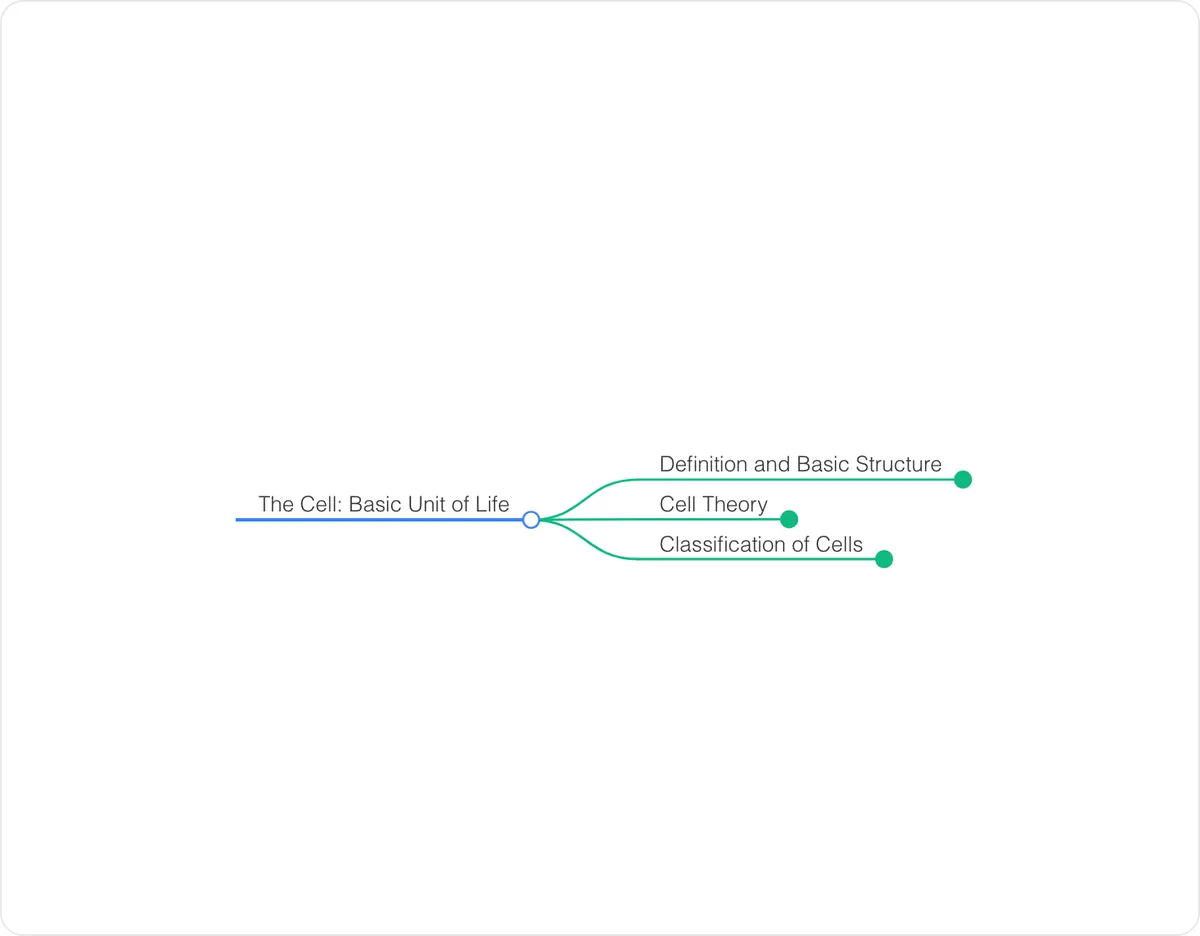
The Cell: Basic Unit of Life
- Definition and Basic Structure
- Definition: The fundamental structural and functional unit of all forms of life or organisms.
- Etymology: Term "cell" derives from Latin "cellula" meaning 'small room'.
- Core Components: Consists of a semipermeable cell membrane enclosing cytoplasm containing genetic material.
- Visibility: Most cells are only visible under a microscope.
- Key Capabilities: Except for highly-differentiated types (e.g., red blood cells, gametes), most cells can replicate and synthesize proteins.
- Motility: Some cell types are motile.
- Origin: Cells emerged on Earth approximately four billion years ago.
- Cell Theory
- Discovery: Cells were discovered by Robert Hooke in 1665.
- Naming: Hooke named them after their resemblance to cells in a monastery.
- Development: Cell theory was developed in 1839 by Matthias Jakob Schleiden and Theodor Schwann.
- Core Tenets:
- All organisms are composed of one or more cells.
- Cells are the fundamental unit of structure and function in all organisms.
- All cells come from pre-existing cells.
- Classification of Cells
- Prokaryotes
- Definition: Single-celled organisms that lack a membrane-bound nucleus.
- Included Organisms: Archaea and bacteria.
- Characteristics:
- Simpler and smaller than eukaryotic cells.
- Lack a nucleus and most other membrane-bound organelles.
- Organelles are typically membrane-less and less complex.
- Cytoplasm contains ribosomes and inclusions.
- DNA is usually a single circular chromosome in a nucleoid region.
- Some have extrachromosomal DNA as plasmids (e.g., encoding antibiotic resistance).
- Possess a prokaryotic cytoskeleton involved in cell shape, polarity, and cytokinesis.
- Can have protein-based organelle-like microcompartments (e.g., gas vesicles, carboxysomes).
- Some have unique membrane-bound organelles like magnetosomes.
- Cell Envelope:
- Encloses bacteria, protecting the interior.
- Typically includes a plasma membrane, cell wall (often peptidoglycan), and sometimes a gelatinous capsule.
- The cell wall provides rigidity, protection, and prevents bursting from osmotic pressure.
- Mycoplasma and Thermoplasma are exceptions, possessing only a cell membrane.
- Reproduction: Bacteria and archaea divide by binary fission.
- Cell-Surface Appendages:
- Can include flagella (for movement) and pili (for attachment and communication).
- Fimbriae are short attachment pili made of pilin, crucial for adhering to host cells.
- Archaea have a similarly structured archaellum.
- Substance Secretion: All prokaryotic cells secrete substances like exoenzymes and extracellular polymeric substances.
- Size: Most are small (0.1 to 5.0 μm), but some, like Thiomargarita magnifica, can be visible to the naked eye.
- Archaea Specifics:
- Cell membranes have unique ether-linked lipids.
- Exhibit unique metabolism like methanogenesis.
- Often extremophiles, thriving in harsh conditions.
- No known archaean pathogens.
- Eukaryotes
- Definition: Cells characterized by the presence of a membrane-bound nucleus.
- Etymology: "Eukaryote" means "true nut" or "true kernel", referring to the nucleus.
- Size: Can be 2 to 100 times larger in diameter than typical prokaryotic cells.
- Cell Types:
- Can be single-celled (e.g., diatoms, yeasts, some protists, some algae).
- Can be multicellular (e.g., animals, plants, most fungi, some algae, seaweed).
- Nucleus:
- The largest membrane-bound organelle in the eukaryotic cell.
- Enclosed in the nuclear membrane.
- Other Organelles:
- Endoplasmic reticulum
- Ribosomes
- Golgi apparatus
- Mitochondria (provide energy)
- Lysosomes
- Peroxisomes
- Endosomes
- Vesicles
- Chloroplasts (in plants, for photosynthesis)
- Endomembrane System:
- Comprises the cell membrane and membranes of organelles (excluding mitochondria).
- Involved in secretory and endocytic pathways for protein and lipid modification, packaging, and transport.
- Cell Wall: Some eukaryotes, including plant cells and fungi, have a cell wall.
- Cellular Extensions: Many cells project one or more cellular extensions; some organelles (e.g., plastids, peroxisomes, mitochondria) also project extensions.
- Development: Most distinct cell types arise from a single totipotent zygote, differentiating into hundreds of types.
- Differentiation Drivers: Driven by environmental cues (e.g., cell-cell interaction) and intrinsic molecular differences.
- Examples of Eukaryotic Cell Types: Animals, plants, fungi, algae, and protists.
- Opisthokonts: A grouping that includes animals and fungi.
- Prokaryotes