Biology mind map
Paste a chapter or your notes and get the structures, processes and key terms of any biology topic as one map.
No sign-up needed: 3 free tries, up to 5,000 characters each.
A real biology mind map
Generated by MindLM with the same pipeline you use, not edited by hand. Expand the nodes, or open your own copy in the editor.
What you add
en.wikipedia.org/wiki/Cell_(biology)
Web page
1 web page becomes 77 nodes
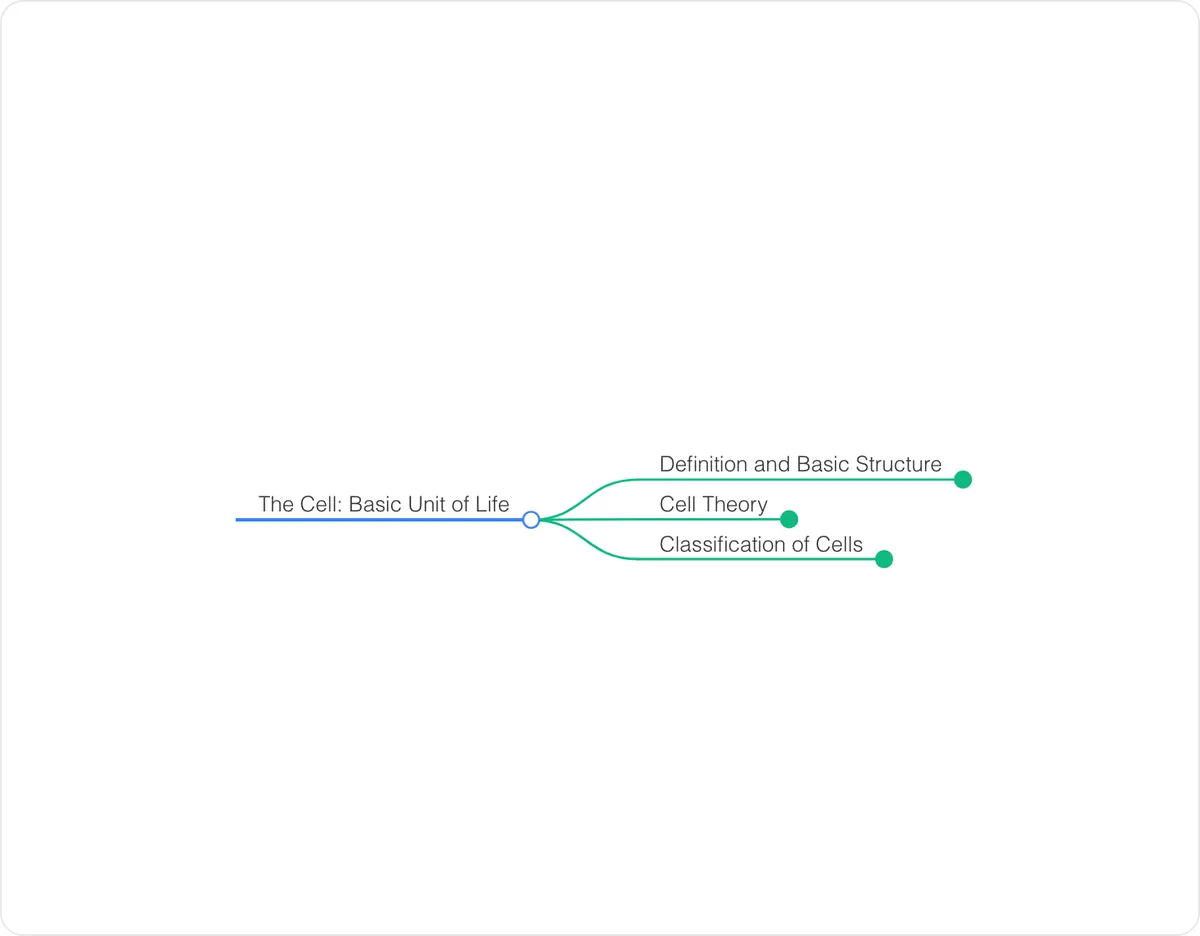 Loading the interactive mind map…
Drag to move, click a node to fold it.
How to structure a biology mind map
A good way to structure it, and a checklist to use when you edit the map yourself.
Definition and scale
What the structure or process is and where it sits — molecule, cell, organ, organism or ecosystem.
Structure
The parts, each as its own branch with its function attached, because biology questions almost always pair the two.
Process steps
Stages in order, with where each happens and what goes in and comes out, such as light reactions then the Calvin cycle.
Regulation and factors
What speeds it up, slows it down or keeps it in balance — enzymes, hormones, limiting factors, feedback loops.
Comparisons and key terms
Plant vs animal cell, mitosis vs meiosis, and the vocabulary you need to define in an exam.
When to use it
Condense a textbook chapter
Upload the chapter as a PDF after signing in, or paste a section, and get every structure and process on one page for revision.
Learn a process step by step
Paste notes on cellular respiration, DNA replication or the immune response and see the stages in order with their inputs and outputs.
Turn a lecture into notes
Map a recorded lecture or a YouTube explainer on Pro, then add your own nodes to the branches you found hard.
How the AI mind map generator works
Paste text or a link
Drop in an article, notes or a webpage URL. Once signed in, upload a PDF or eBook.
Get the map in 1–3 minutes
AI reads the content, keeps its structure and lays it out as branches you can open one at a time.
Navigate, edit, export
Collapse and expand branches, rename nodes, then export as PNG, Markdown, or XMind to use anywhere.
FAQ
Can it include diagrams of cells or organs?
No. MindLM builds text mind maps: each part and step is a node, not a labeled drawing. Many students keep the map next to the textbook diagram and use the map to learn what each label does.
Does it keep chemical equations?
Equations and figures in your source are kept as text on the relevant node, for example the overall equation for photosynthesis.
Which languages are supported?
Your notes can be in English, Chinese or most major languages, and you can choose the language of the map separately — useful for studying biology in a second language.
Keep exploring
Ready to map your next PDF, video, or notes?
No setup needed. Start in your browser instantly.
Encrypted storage · Your data never trains AI models · Export anytimeHow we protect your data