Mind map of Newton's laws of motion: physics notes
Pasted text · 39 nodes
What you add
Newton's laws of motion: physics notes
Pasted text
381 words becomes 39 nodes
Physics notes written for this example
Interactive mind map
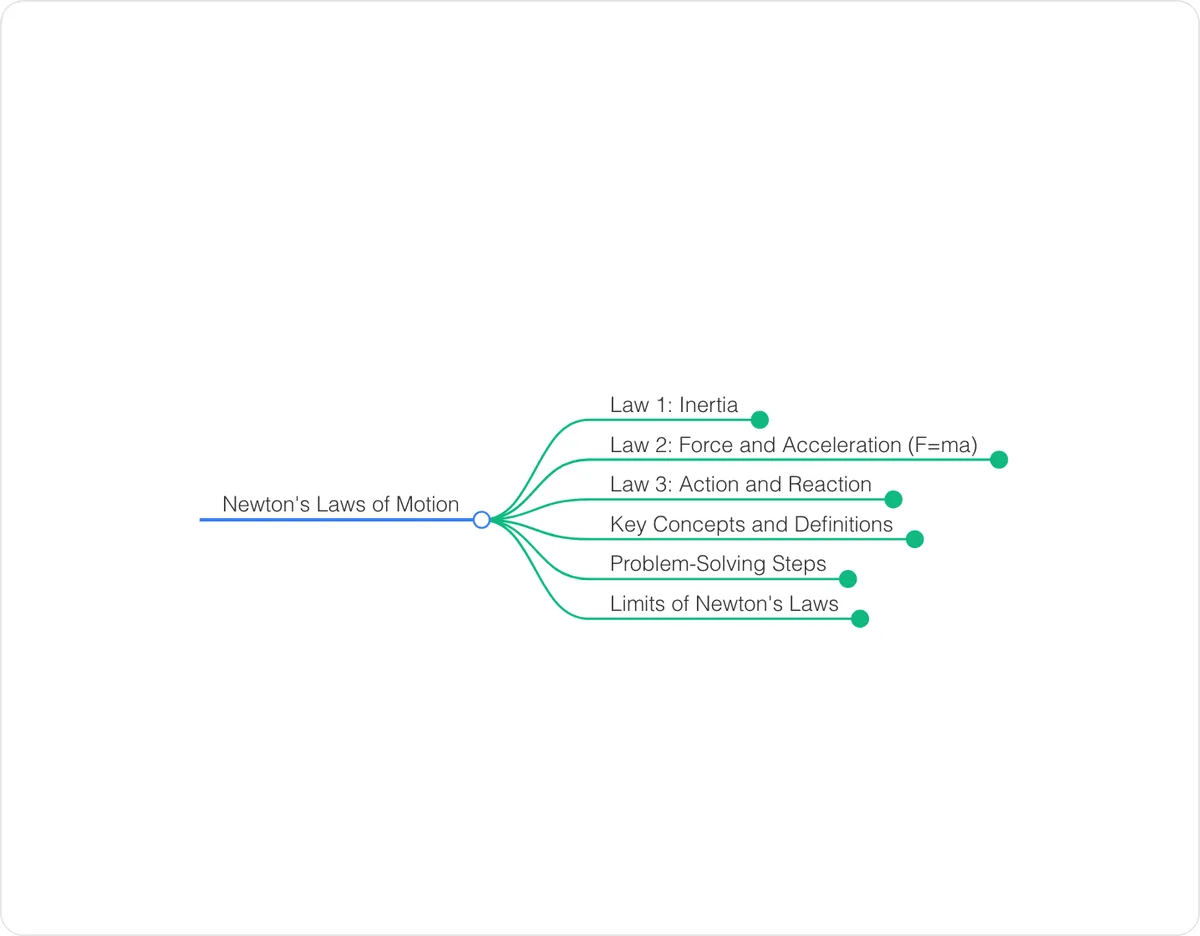 Loading the interactive mind map…
Drag to move, click a node to fold it.
Summary
These physics notes set out Newton's three laws of motion and how to use them. The first law says an object stays at rest or keeps moving at constant velocity unless a resultant force acts, which is why passengers lurch forward when a bus brakes; the notes correct the common belief that motion needs a force to keep going. The second law, F = ma, links resultant force, mass and acceleration, with a worked example of a 1,000 kg car and an explanation of terminal velocity. The third law says forces come in equal and opposite pairs acting on different objects, as when a rocket pushes exhaust gas back. The notes also define force, mass, weight and resultant force, give three problem-solving steps starting with a free-body diagram, and note that the laws break down near light speed and at atomic scales.
Key takeaways
- First law: without a resultant force, an object keeps its state of motion.
- Moving objects slow down because of friction and air resistance, not a lack of force.
- Second law: F = ma; a 2,000 N force accelerates a 1,000 kg car at 2 m/s².
- Third law: equal and opposite forces act on different objects and never cancel.
- Solve problems with a free-body diagram, then the resultant force, then F = ma.
All 39 nodes
The full mind map as an outline.
Newton's Laws of Motion
- Law 1: Inertia
- An object remains at rest or in uniform motion in a straight line unless acted upon by an external force.
- Inertia: Tendency to resist changes in motion.
- Greater mass implies greater inertia.
- Examples:
- Passengers lurch forward when a bus brakes.
- A book on a table remains stationary due to balanced forces.
- Common Misconception: Moving objects require a continuous force to maintain motion. They slow down due to friction and air resistance.
- Law 2: Force and Acceleration (F=ma)
- The acceleration of an object is directly proportional to the net force acting on it and inversely proportional to its mass.
- Formula: Resultant force = mass × acceleration (F = ma).
- Relationship:
- More force leads to greater acceleration.
- More mass leads to less acceleration for the same force.
- Alternative formulation: Force equals the rate of change of momentum (F = Δp / Δt).
- Example: A 1,000 kg car with a 2,000 N resultant force accelerates at 2 m/s².
- Terminal Velocity: A falling object accelerates until air resistance equals its weight, resulting in zero net force and constant velocity.
- Law 3: Action and Reaction
- For every action, there is an equal and opposite reaction.
- Conditions:
- The two forces act on different objects.
- They are of the same type.
- They do not cancel each other out.
- Examples:
- A rocket expels gas backward, and the gas propels the rocket forward.
- When walking, your foot pushes backward on the ground, and the ground pushes you forward.
- Key Concepts and Definitions
- Force: A push or a pull, measured in Newtons (N). It's a vector quantity, meaning direction is important.
- Mass: The amount of matter in an object, measured in kilograms.
- Weight: The force of gravity acting on a mass (W = mg), with 'g' being approximately 9.8 N/kg near Earth's surface.
- Resultant Force: The single force that produces the same effect as all forces acting on an object combined.
- Problem-Solving Steps
- Draw a free-body diagram illustrating all forces acting on the object.
- Calculate the resultant force.
- Apply Newton's second law (F = ma), ensuring units are Newtons (N), kilograms (kg), and meters per second squared (m/s²).
- Limits of Newton's Laws
- Near the speed of light: Newton's laws break down and are superseded by special relativity.
- Atomic scales: At the quantum level, these laws are not applicable and are replaced by quantum mechanics.