Mind map of But what is a neural network? | Deep learning chapter 1
YouTube · 18:40 · 101 nodes
What you add
But what is a neural network? | Deep learning chapter 1
YouTube · 18:40Pro
18:40 · ~3,400 words becomes 101 nodes
Interactive mind map
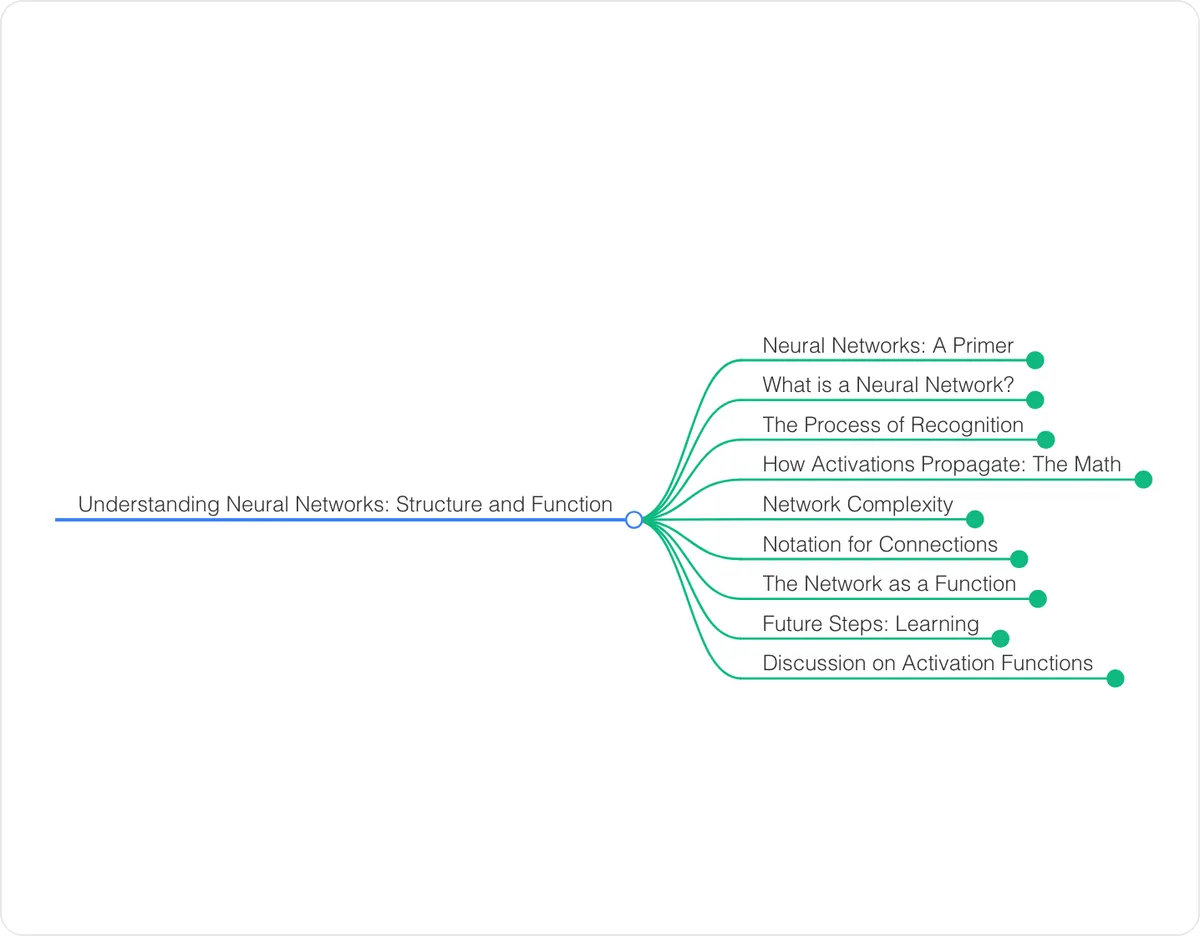 Loading the interactive mind map…
Drag to move, click a node to fold it.
Open in editorFree account
All 101 nodes
The full mind map as an outline.
Understanding Neural Networks: Structure and Function
- Neural Networks: A Primer
- Human Brain Analogy
- Effortless recognition of complex patterns (e.g., handwritten digits)
- Visual cortex processes diverse inputs as same idea
- The Challenge of Programming AI
- Simple concept (recognizing a '3') becomes difficult for traditional programming
- Highlights the need for Machine Learning and Neural Networks
- Relevance and Importance
- Present and future of technology
- Human Brain Analogy
- What is a Neural Network?
- Inspired by the Brain
- Neurons: Units holding numbers between 0 and 1
- Activation: The numerical value held by a neuron
- Layered Structure
- Input Layer
- Represents pixels of the input image (e.g., 28x28 = 784 neurons)
- Activation represents grayscale value (0 for black, 1 for white)
- Output Layer
- 10 neurons, each representing a digit (0-9)
- Activation indicates confidence in the digit recognition
- Hidden Layers
- Intermediate layers between input and output
- Responsible for complex pattern recognition
- Example: Two hidden layers with 16 neurons each (arbitrary choice)
- Input Layer
- Information Flow
- Activations in one layer determine activations in the next
- Loosely analogous to biological neuron firing
- Inspired by the Brain
- The Process of Recognition
- Trained Network Behavior
- Input image activates input layer neurons
- Pattern of activations propagates through layers
- Output layer's brightest neuron indicates the recognized digit
- Hope for Hidden Layers: Hierarchical Feature Detection
- Recognizing digits by combining components
- Example: '9' has a loop and a line
- Potential role of hidden layers:
- Second-to-last layer: Detects subcomponents (e.g., a loop)
- Second layer: Detects fundamental features (e.g., edges)
- Generalizability: Useful for other image recognition tasks
- Broader applications: Speech parsing, abstract thought
- Trained Network Behavior
- How Activations Propagate: The Math
- Core Mechanism: Combining Layer Activations
- Goal: Combine pixels into edges, edges into patterns, patterns into digits
- Detecting Patterns (e.g., an edge in a specific region)
- Parameters: Weights and Biases
- Weights: Numbers associated with connections between neurons
- Represent the importance of a connection
- Organized into a grid (green for positive, red for negative)
- Weighted Sum: Sum of activations from the previous layer multiplied by their respective weights
- Bias: An additional number added to the weighted sum
- Represents a threshold for neuron activation
- Weights: Numbers associated with connections between neurons
- Parameters: Weights and Biases
- Squishing Output: Activation Functions
- Goal: Output activation between 0 and 1
- Sigmoid Function (Logistic Curve)
- Squishes any real number into the [0, 1] range
- Input 0 maps to 0.5, very negative to 0, very positive to 1
- Output Activation: A measure of how positive the weighted sum is, after applying the sigmoid
- Core Mechanism: Combining Layer Activations
- Network Complexity
- Number of Parameters
- Weights and biases for each connection
- Example: 784 neurons * 16 neurons/layer * 2 hidden layers + output layer connections
- Total: Approximately 13,000 weights and biases
- "Learning" Defined
- Finding the correct settings for all weights and biases
- Enables the network to solve the intended problem
- Manual Tuning (Thought Experiment)
- Satisfying to understand what parameters mean
- Aids in debugging and improving the network
- Number of Parameters
- Notation for Connections
- Vector Representation
- Activations of a layer organized into a column vector
- Matrix Representation
- Weights organized into a matrix
- Matrix-vector product computes weighted sums efficiently
- Bias Vector
- Biases organized into a vector and added to the matrix-vector product
- Applying Activation Function
- Applied element-wise to the resulting vector
- Compact Expression
- sigmoid(W * a + b)
- W: Weight matrix, a: Activation vector, b: Bias vector
- Vector Representation
- The Network as a Function
- Neurons as Functions
- Take previous layer outputs, produce a value between 0 and 1
- Entire Network as a Function
- Input: 784 pixel values
- Output: 10 digit probabilities
- Complex function with ~13,000 parameters
- Neurons as Functions
- Future Steps: Learning
- How the network learns appropriate weights and biases from data
- Deeper dive into what the specific network is doing
- Discussion on Activation Functions
- Sigmoid Function
- Early choice, inspired by biological analogy
- Can be difficult to train ("old school")
- ReLU (Rectified Linear Unit)
- Modern choice, widely used
- max(0, a) where a is the weighted sum
- Easier to train, especially for deep networks
- Simplification of biological activation (either off or on)
- Sigmoid Function