Mind map of Causes of World War I: class notes
Pasted text · 47 nodes
What you add
Causes of World War I: class notes
Pasted text
501 words becomes 47 nodes
Class notes written for this example
Interactive mind map
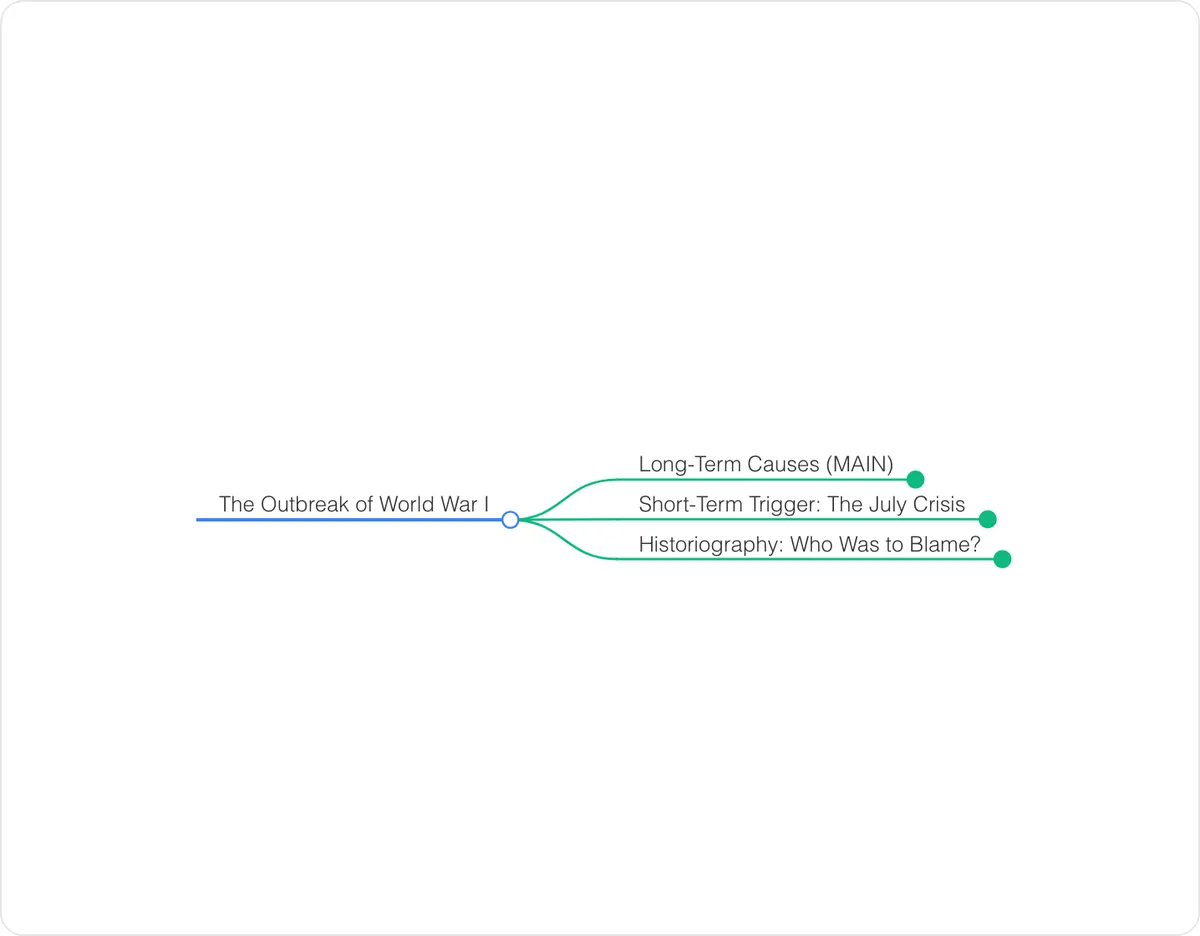 Loading the interactive mind map…
Drag to move, click a node to fold it.
Summary
These history class notes ask how one assassination in the Balkans became a European war within five weeks. They split the answer into the long-term MAIN causes and the short-term July Crisis. Militarism covers conscript armies, the Anglo-German naval race after HMS Dreadnought in 1906, and the Schlieffen Plan. Alliances run from the Dual Alliance of 1879 to the Triple Entente of 1907, dividing Europe into two armed blocs. Imperialism and nationalism add the Moroccan Crises, the annexation of Bosnia in 1908 and the Balkan Wars. The July Crisis is traced day by day, from the Sarajevo assassination on 28 June 1914 and Germany's blank cheque to Britain's declaration of war on 4 August. The notes close with the blame debate, from the Versailles war guilt clause to Fritz Fischer and Christopher Clark.
Key takeaways
- Long-term causes follow MAIN: militarism, alliances, imperialism and nationalism.
- Two blocs formed between 1879 and 1907: the Triple Alliance against the Triple Entente.
- The trigger: Archduke Franz Ferdinand was shot in Sarajevo on 28 June 1914.
- The July Crisis took five weeks, from the blank cheque to Britain's entry on 4 August.
- Blame is still debated: Versailles Article 231, Fischer (1961), Clark's The Sleepwalkers (2012).
All 47 nodes
The full mind map as an outline.
The Outbreak of World War I
- Long-Term Causes (MAIN)
- Militarism
- Arms Race on Land: Continental powers built mass conscript armies with detailed mobilization timetables.
- Naval Race:
- Between Britain and Germany following Germany's Navy Laws of 1898 and 1900.
- Britain launched HMS Dreadnought in 1906, initiating a race to build similar battleships.
- War Plans: Mobilization schedules and pre-existing war plans (e.g., Germany's Schlieffen Plan) contributed to rapid escalation, involving attacking France through Belgium before turning to Russia.
- Alliances
- Dual Alliance (1879): Germany and Austria-Hungary.
- Triple Alliance (1882): Italy joined Germany and Austria-Hungary.
- Franco-Russian Alliance (1892-1894): A military convention formalized these ties.
- Entente Cordiale (1904): Settled colonial disputes between Britain and France.
- Triple Entente (1907): Completed by the Anglo-Russian Convention, uniting Britain, France, and Russia.
- Effect: Divided Europe into two armed blocs, increasing the risk that a local conflict would draw in multiple great powers.
- Imperialism
- Colonial Competition: Intense rivalry for colonies, particularly in Africa.
- Moroccan Crises (1905, 1911):
- Germany challenged French control of Morocco.
- Britain supported France on both occasions, strengthening the Entente Cordiale.
- Nationalism
- Pan-Slavism: Serbia's ambition to lead the South Slavs, with Russia as its protector.
- Austro-Hungarian Annexation (1908): Austria-Hungary annexed Bosnia and Herzegovina, provoking Serbia and humiliating Russia.
- Balkan Wars (1912-1913):
- Serbia doubled its territory by fighting the Ottoman Empire.
- Austria-Hungary perceived Serbia's growth as a significant threat.
- Militarism
- Short-Term Trigger: The July Crisis
- Assassination in Sarajevo (June 28, 1914)
- Gavrilo Princip, a Bosnian Serb with ties to the Black Hand secret society, assassinated Archduke Franz Ferdinand and his wife Sophie.
- Escalation of Diplomatic and Military Actions
- "Blank Cheque" (July 5-6): Germany assured Austria-Hungary of its full support in any action against Serbia.
- Austro-Hungarian Ultimatum (July 23): A deliberately unacceptable list of demands sent to Serbia.
- Serbian Response (July 25): Serbia accepted most terms but refused a few, leading Austria-Hungary to break diplomatic relations.
- Declaration of War (July 28): Austria-Hungary declared war on Serbia.
- Russian Mobilization (July 30): Russia ordered a general mobilization to support Serbia.
- German Declarations of War (August 1, 3): Germany declared war on Russia, and subsequently on France.
- German Invasion of Belgium (August 4): Germany invaded neutral Belgium.
- British Declaration of War (August 4): Britain declared war on Germany due to its treaty obligations to protect Belgian neutrality.
- Assassination in Sarajevo (June 28, 1914)
- Historiography: Who Was to Blame?
- Treaty of Versailles (1919)
- Article 231 ("War Guilt Clause"): Officially placed responsibility for the war on Germany and its allies.
- 1920s-1930s Historical Views
- Many historians argued that the great powers collectively "stumbled" into war, with no single nation solely responsible.
- Fritz Fischer's Argument (1961)
- Fritz Fischer contended that Germany deliberately sought war to achieve its goal of becoming a world power.
- Christopher Clark's "The Sleepwalkers" (2012)
- This work suggests that leaders on all sides gradually entered into a war that none fully intended or comprehended.
- Treaty of Versailles (1919)