Book summary mind map
Upload an eBook or paste a chapter and get the argument, key ideas and examples on one page.
No sign-up needed: 3 free tries, up to 5,000 characters each.
A real book summary mind map
Generated by MindLM with the same pipeline you use, not edited by hand. Expand the nodes, or open your own copy in the editor.
What you add
pg71-images-3.epub
EPUB
~9,400 words becomes 64 nodes
On the Duty of Civil Disobedience
Henry David Thoreau, Project Gutenberg eBook #71 (public domain)
View source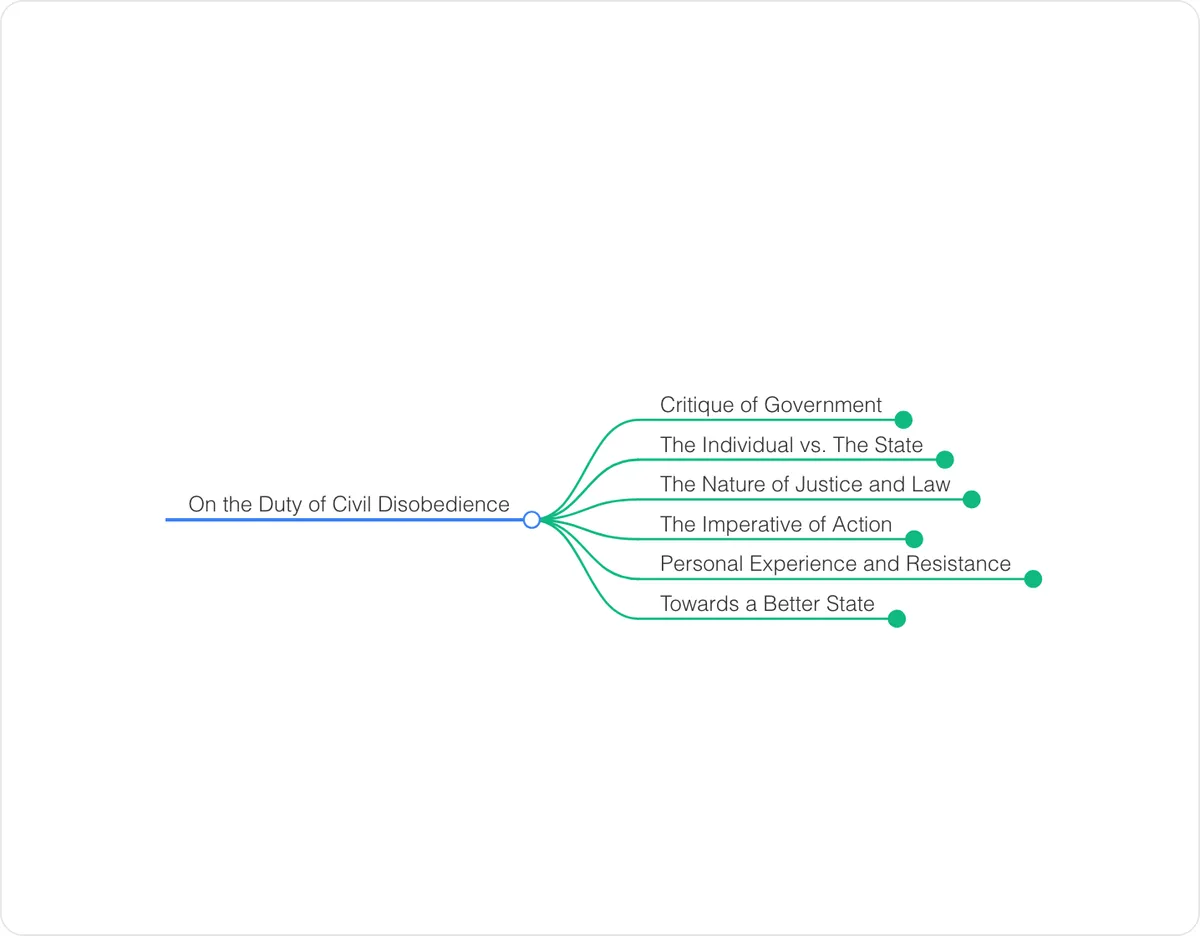 Loading the interactive mind map…
Drag to move, click a node to fold it.
How to structure a book summary mind map
This is how MindLM organizes the map, and a good checklist when you edit it yourself.
Central argument
The one-sentence answer to "what is this book saying?" sits at the root, so every branch can be checked against it.
Parts or chapters
Follow the author's own structure for non-fiction; for fiction, use acts or chapters so the plot stays in order.
Key ideas
Under each part, the claims the author makes — phrased as statements you could agree or disagree with.
Evidence and examples
The stories, studies and quotes that support each idea. These are what make the idea memorable a month later.
Your takeaways
Add a branch of your own after generating: what you will apply, and where you disagree.
When to use it
Review a book you finished months ago
Upload the EPUB and get the whole argument back in five minutes, without re-reading.
Prepare for a book club or class discussion
Map the chapters for this week, then bring the branches you want to argue about.
Decide whether a book is worth reading
Map the introduction or a sample chapter first and see if the argument holds your interest.
How it works
Paste text or a link
Drop in an article, notes or a webpage URL. Once signed in, upload a PDF or eBook.
Get the map in 1–3 minutes
AI reads the content, keeps its structure and lays it out as branches you can open one at a time.
Navigate, edit, export
Collapse and expand branches, rename nodes, then export as PNG, Markdown, or XMind to use anywhere.
FAQ
Can I upload a whole book?
Yes. Sign in and upload an EPUB or PDF; the whole book is processed, not just the first chapter, and the table of contents shapes the first-level branches. The free trial on this page takes up to 5,000 characters of pasted text.
Does it work for fiction?
Yes, though the map will follow plot, characters and themes rather than arguments. Paste chapter notes like the sample above for the clearest result.
Can the summary be in a different language from the book?
Yes. Choose the output language separately — for example, summarize an English book into a Chinese mind map.
Keep exploring
Tools for this topic
Ready to map your next PDF, video, or notes?
No setup needed. Start in your browser instantly.
Encrypted storage · Your data never trains AI models · Export anytimeHow we protect your data