Psychology mind map
Paste your notes on any topic and get its theories, key studies, applications and evaluation as one map.
No sign-up needed: 3 free tries, up to 5,000 characters each.
A real psychology mind map
Generated by MindLM with the same pipeline you use, not edited by hand. Expand the nodes, or open your own copy in the editor.
What you add
Classical and operant conditioning: psychology notes
Pasted text
384 words becomes 48 nodes
Psychology notes written for this example
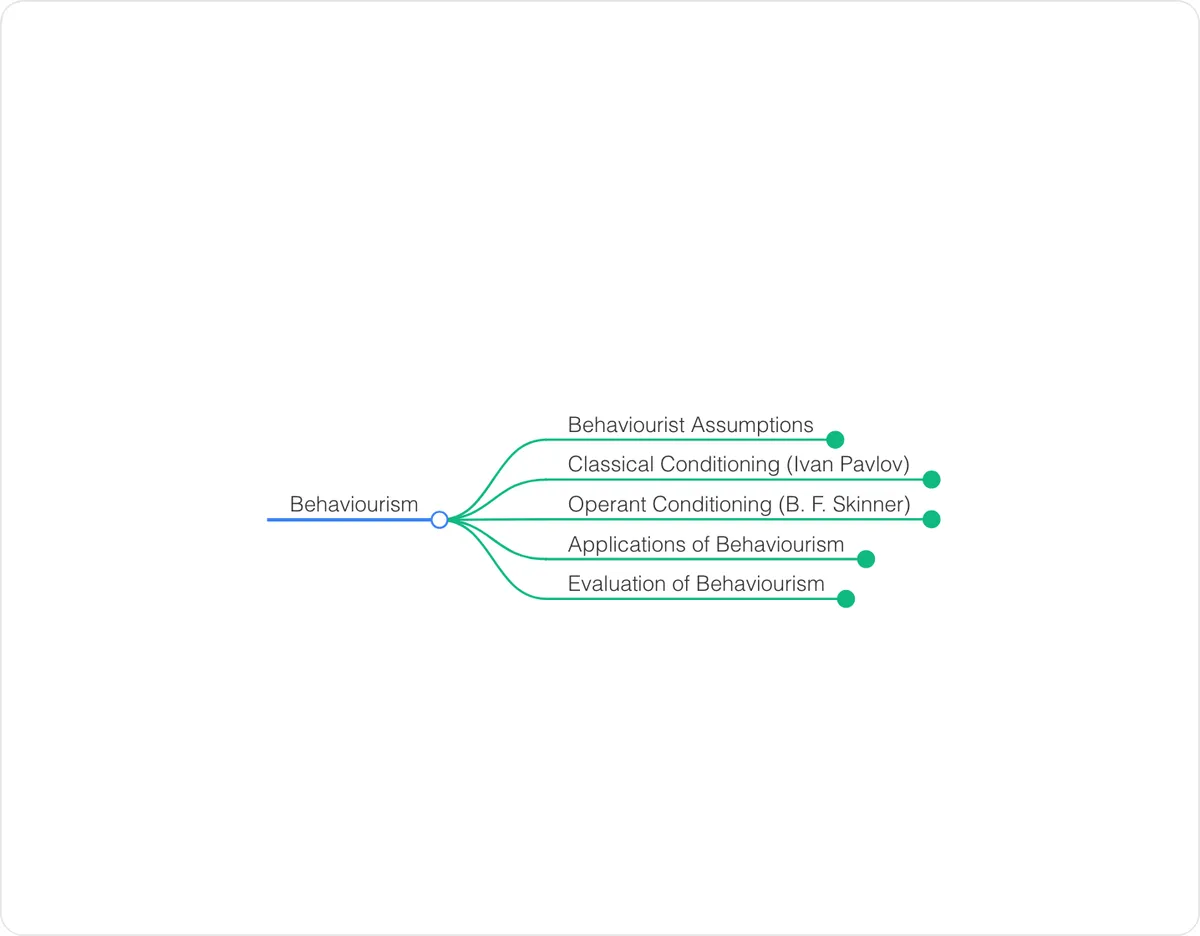 Loading the interactive mind map…
Drag to move, click a node to fold it.
How to structure a psychology mind map
A good way to structure it, and a checklist to use when you edit the map yourself.
Key concepts
The terms the theory is built on, each defined in a few words — the vocabulary exam questions use.
Theory or model
Who proposed it and when, and its parts or stages as child branches.
Key studies
Each study with researcher, year, method and finding as leaves, so you can quote it as evidence.
Applications
Where the theory is used in therapy, education, work or everyday life.
Evaluation
Strengths, weaknesses and competing explanations kept apart — the branch most essay marks depend on.
When to use it
Revise a topic for an exam
Paste your notes on memory, attachment or social influence and see theories, studies and evaluation side by side.
Plan an extended answer
Use the evaluation branch as the skeleton of a long answer: one point, one study as evidence, one counterpoint.
Summarize a journal article
Upload the PDF after signing in and get its aim, method, results and limitations as branches before you read it closely.
How the AI mind map generator works
Paste text or a link
Drop in an article, notes or a webpage URL. Once signed in, upload a PDF or eBook.
Get the map in 1–3 minutes
AI reads the content, keeps its structure and lays it out as branches you can open one at a time.
Navigate, edit, export
Collapse and expand branches, rename nodes, then export as PNG, Markdown, or XMind to use anywhere.
FAQ
Will it get study details right?
When you paste notes or a source, names, years and findings come from that text. If you type only a topic, the AI writes from general knowledge, so check researchers and dates against your textbook before an exam.
Can it compare two theories?
Yes. Paste notes on both, such as the multi-store and working memory models, and each becomes its own branch with its evidence and criticisms, so the comparison is easy to read.
Can I map a whole chapter?
Yes. Sign in and upload the chapter as a PDF or EPUB. The free trial on this page takes pasted text up to 5,000 characters.
Keep exploring
Ready to map your next PDF, video, or notes?
No setup needed. Start in your browser instantly.
Encrypted storage · Your data never trains AI models · Export anytimeHow we protect your data