Physics mind map
Paste a chapter or your notes and get the laws, formulas, examples and common mistakes of any physics topic as one map.
No sign-up needed: 3 free tries, up to 5,000 characters each.
A real physics mind map
Generated by MindLM with the same pipeline you use, not edited by hand. Expand the nodes, or open your own copy in the editor.
What you add
Newton's laws of motion: physics notes
Pasted text
381 words becomes 39 nodes
Physics notes written for this example
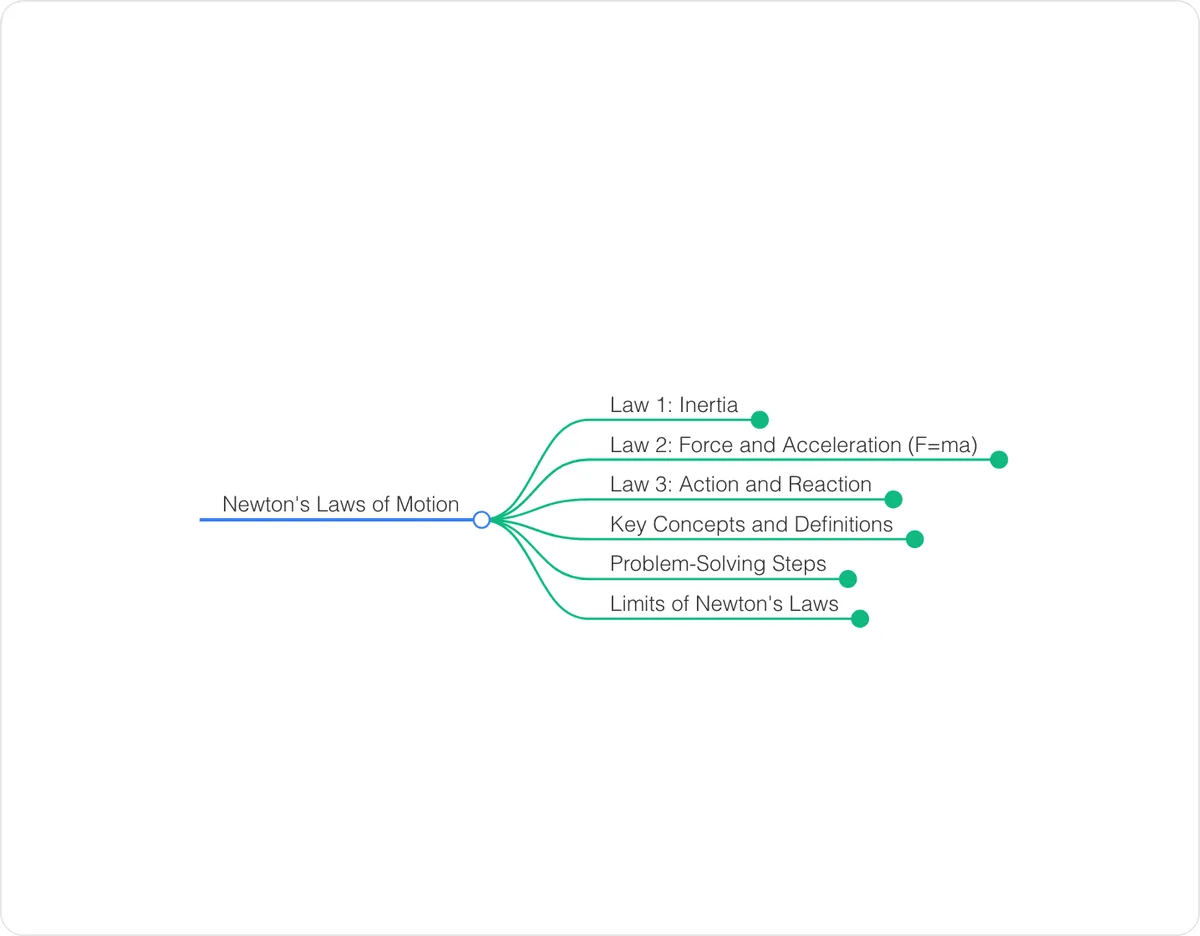 Loading the interactive mind map…
Drag to move, click a node to fold it.
How to structure a physics mind map
A good way to structure it, and a checklist to use when you edit the map yourself.
Quantities and units
Every quantity with its symbol and SI unit, since half the marks in a calculation are units.
Laws and principles
Each law stated in words first, with its conditions — "at constant temperature", "no resultant force".
Formulas
Equations as leaves under the law they come from, so you remember when each one applies.
Examples
Everyday examples and a worked calculation for each idea.
Misconceptions
The mistakes examiners look for, such as thinking a moving object needs a force to keep moving.
When to use it
Build a formula sheet with context
Paste a unit of notes and see every formula under the law it belongs to, with its units and conditions.
Understand a topic before the lesson
Map a textbook section, or a YouTube explainer on Pro or Max, to see how the ideas connect before working through problems.
Find gaps before an exam
Compare the map with the syllabus and add your own nodes where a topic is missing.
How the AI mind map generator works
Paste text or a link
Drop in an article, notes or a webpage URL. Once signed in, upload a PDF or eBook.
Get the map in 1–3 minutes
AI reads the content, keeps its structure and lays it out as branches you can open one at a time.
Navigate, edit, export
Collapse and expand branches, rename nodes, then export as PNG, Markdown, or XMind to use anywhere.
FAQ
Does it keep formulas?
Formulas in your notes are kept as text on the relevant node, such as F = ma or P = IV. Complex notation is shown the way you typed it rather than typeset.
Can it solve physics problems?
No. It organizes material into a map. Worked examples in your notes stay on the map, but it does not solve new problems for you.
Can I map a whole chapter?
Yes. Sign in and upload the chapter as a PDF or EPUB. The free trial on this page takes pasted text up to 5,000 characters.
Keep exploring
Ready to map your next PDF, video, or notes?
No setup needed. Start in your browser instantly.
Encrypted storage · Your data never trains AI models · Export anytimeHow we protect your data