Chemistry mind map
Paste a chapter or your notes and get the concepts, types, properties and examples of any chemistry topic as one map.
No sign-up needed: 3 free tries, up to 5,000 characters each.
A real chemistry mind map
Generated by MindLM with the same pipeline you use, not edited by hand. Expand the nodes, or open your own copy in the editor.
What you add
Chemical bonding: chemistry notes
Pasted text
349 words becomes 55 nodes
Chemistry notes written for this example
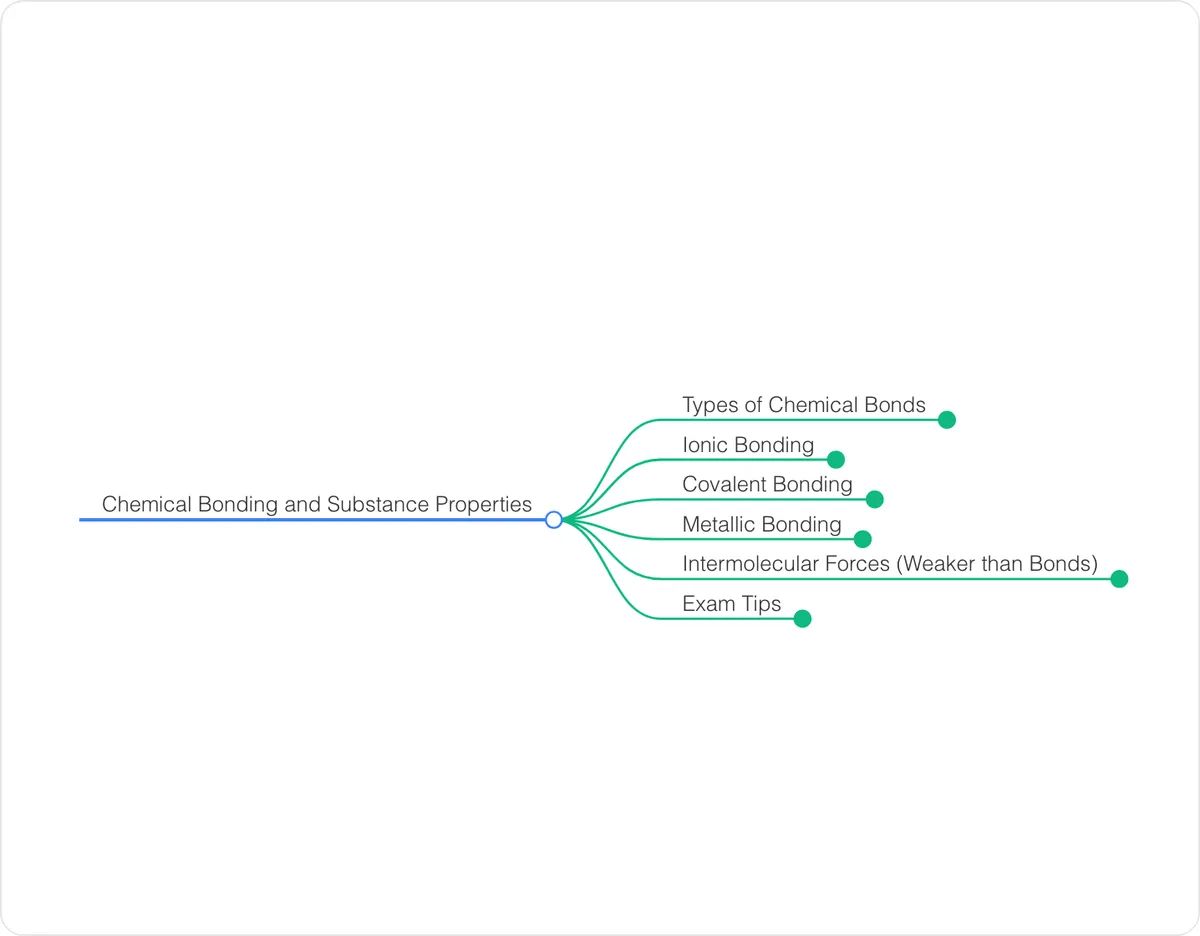 Loading the interactive mind map…
Drag to move, click a node to fold it.
How to structure a chemistry mind map
A good way to structure it, and a checklist to use when you edit the map yourself.
Definitions
The precise wording examiners expect, such as "a Brønsted–Lowry acid is a proton donor".
Types and examples
Each type as a branch with named substances under it — ionic vs covalent, strong vs weak acids.
Properties and why
Each property paired with its explanation in terms of particles, which is what most marks are for.
Reactions and equations
General word equations first, then balanced and ionic equations as leaves.
Exam traps
The distinctions students mix up: strong vs concentrated, bonds vs intermolecular forces.
When to use it
Condense a unit before a test
Paste your notes on bonding, rates or organic chemistry and get every type, property and example in one view.
Link properties to structure
See each property next to the structure that explains it, so "why does graphite conduct?" has an obvious answer.
Turn a lab write-up into a summary
Paste a practical write-up and get the aim, method, results and sources of error as branches for revision.
How the AI mind map generator works
Paste text or a link
Drop in an article, notes or a webpage URL. Once signed in, upload a PDF or eBook.
Get the map in 1–3 minutes
AI reads the content, keeps its structure and lays it out as branches you can open one at a time.
Navigate, edit, export
Collapse and expand branches, rename nodes, then export as PNG, Markdown, or XMind to use anywhere.
FAQ
Does it keep chemical formulas and equations?
Formulas and equations in your notes are kept as text on the relevant node, such as H+ + OH- → H2O. They are not typeset like a textbook, so check subscripts and charges when you review the map.
Can it draw molecules or reaction diagrams?
No. MindLM builds text mind maps, so structures are described in words rather than drawn. Keep your textbook diagrams next to the map.
Which languages are supported?
Your notes can be in English, Chinese or most major languages, and you can choose the language of the map separately.
Keep exploring
Ready to map your next PDF, video, or notes?
No setup needed. Start in your browser instantly.
Encrypted storage · Your data never trains AI models · Export anytimeHow we protect your data