Concept Map vs Mind Map: How They Differ and When to Use Each
Concept map vs mind map: one links ideas with labeled arrows, the other branches out from one topic. Compare structure, examples and when to use each.
Both are diagrams of ideas. A mind map branches out from one topic; a concept map shows how many ideas connect, with every link labeled.
Make a mind map from your notes →
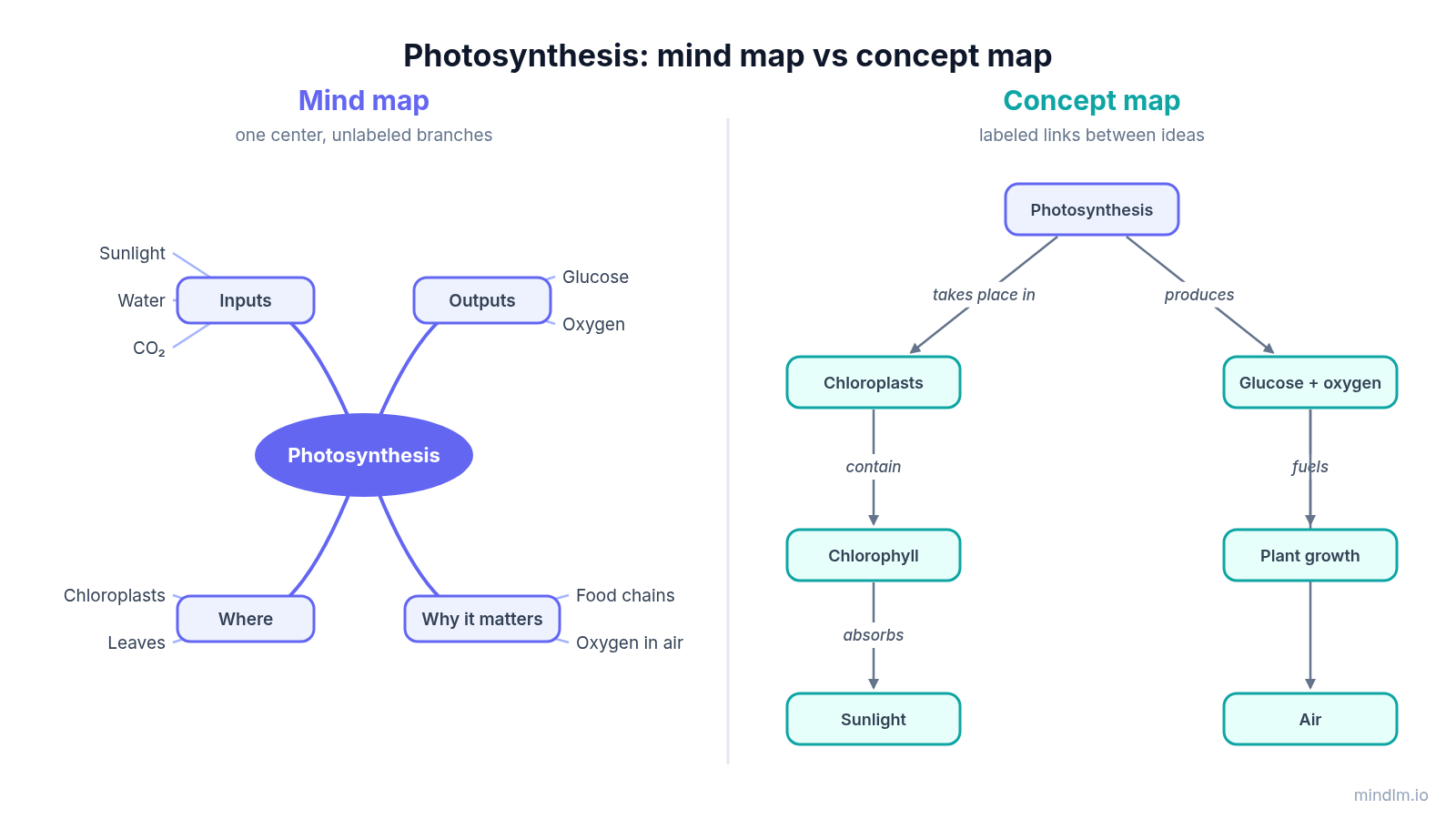
The same topic, photosynthesis, as a mind map (left) and a concept map (right).
The short version of concept map vs mind map: a mind map starts from one central topic and branches outward into subtopics and details, like a tree seen from above. A concept map connects many ideas with arrows, and every arrow carries a label that says how the two ideas are related ("causes", "is part of", "requires"). A mind map answers "what does this topic include?" A concept map answers "how do these ideas affect each other?"
People mix the two up because both use boxes or bubbles joined by lines. The difference is in what the lines mean, and that changes when each one is useful.
Where each one comes from
Mind maps were popularized in the 1970s by British author Tony Buzan as a note-taking and memory technique. The rules he taught are simple: one central image or word, main branches radiating out, keywords on branches, and sub-branches for detail.
Concept maps were developed in the 1970s by Joseph Novak and his research team at Cornell University, building on David Ausubel's theory that people learn by connecting new ideas to what they already know. Novak's team used them to track how students' understanding of science changed over time. In the IHMC report by Novak and Cañas, a concept map is built around a focus question, with concepts in boxes and linking words on the lines between them, so that each pair reads as a sentence.
The key differences
| Mind map | Concept map | |
|---|---|---|
| Starting point | One central topic | A focus question, often with several key concepts |
| Shape | Radial tree, branching outward | Network, usually arranged top to bottom from general to specific |
| What lines mean | "This belongs under that" | Whatever the label says: causes, requires, produces, is a type of |
| Line labels | None | Required; every link has linking words |
| Cross-links | Rare; branches stay separate | Encouraged; links between distant parts of the map are the point |
| Reads as | An outline | A set of statements ("Plants – need – sunlight") |
| Speed | Fast to make | Slower; takes thought to name each relationship |
| Best for | Notes, summaries, brainstorming, planning | Understanding systems, showing cause and effect, assessing understanding |
Structure: tree or network
In a mind map, every idea has one parent. "Chlorophyll" sits under "Inputs", which sits under "Photosynthesis". That makes mind maps easy to read and easy to turn into an outline.
A concept map lets an idea connect to several others. "Sunlight" might link to "chlorophyll" (absorbed by), to "energy" (provides) and to "leaf position" (affects). This web of links is harder to read at a glance but captures relationships a tree cannot.
Labels: the real dividing line
If you remember one thing, remember this. Lines in a concept map have words on them, and those words do the explaining. "Water → is absorbed by → roots" is a complete idea. Lines in a mind map are unlabeled; the meaning is just "part of" or "related to".
That is why concept maps are popular for checking understanding. A student who can label the link between "carbon dioxide" and "glucose" correctly understands something a list of keywords does not prove.
The same topic, mapped both ways
Take photosynthesis.
As a mind map
-
Photosynthesis
- Inputs: sunlight, water, carbon dioxide
- Outputs: glucose, oxygen
- Where it happens: chloroplasts, leaves
- Why it matters: food chains, oxygen in the air
As a concept map (read each line as a sentence)
- Photosynthesis → takes place in → chloroplasts
- Chloroplasts → contain → chlorophyll
- Chlorophyll → absorbs → sunlight
- Sunlight → provides energy to → convert carbon dioxide and water
- Photosynthesis → produces → glucose and oxygen
- Glucose → is used by → the plant for growth
- Oxygen → is released into → the air, which animals breathe
The mind map is a tidy inventory. The concept map is a chain of explanation. Neither is better; they do different jobs.
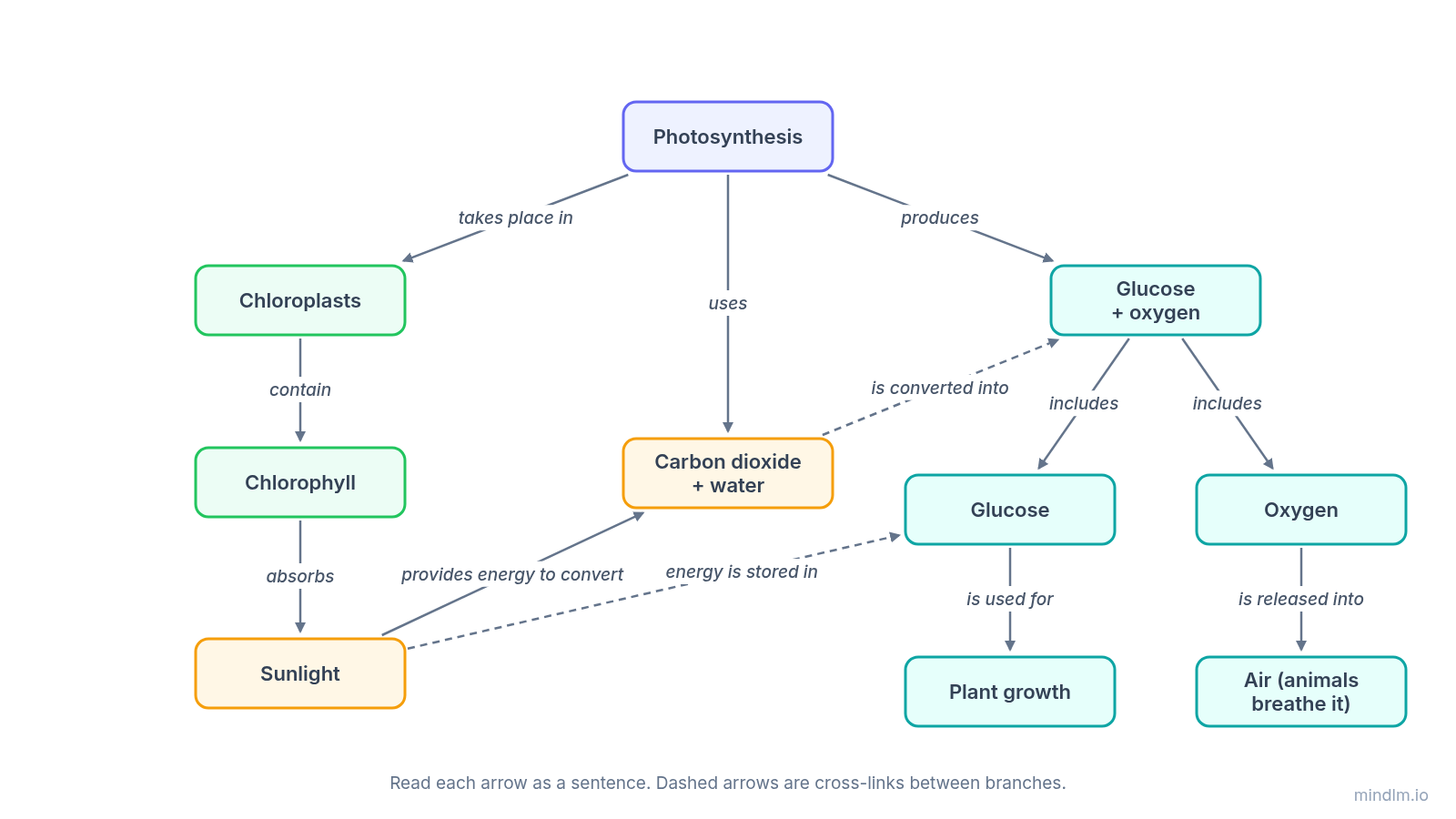
A concept map of photosynthesis. Each arrow's label turns the link into a statement.
When to use a mind map
- Taking notes during a lecture, meeting or video, when speed matters.
- Summarizing a chapter, article, paper or transcript into its main points.
- Brainstorming ideas around a single goal or problem.
- Planning an essay, presentation or project, where the output needs to become an ordered outline.
- Reviewing before an exam, when you want the whole topic on one page.
When to use a concept map
- Understanding a system where parts affect each other: ecosystems, the economy, a disease pathway, a software architecture.
- Showing cause and effect across several steps.
- Assessing understanding. Teachers ask students to build one because the labels reveal misconceptions.
- Answering a focus question, such as "How does the water cycle affect weather?"
- Integrating knowledge from several sources, where cross-links between topics matter more than the outline.
A practical approach many students use: start with a mind map to collect everything you know or have read, then build a concept map for the parts where relationships matter. The mind map is the inventory; the concept map is the explanation.
How to make each one
Making a mind map
- Write the topic in the center.
- Add main branches for the big subtopics.
- Add sub-branches for details, examples and facts.
- Keep words short; one idea per branch.
Making a concept map
- Write a focus question at the top.
- List the 10–20 key concepts that the question involves.
- Rank them from most general to most specific and arrange them top to bottom.
- Draw arrows between related concepts and write a linking phrase on each one.
- Look for cross-links between different parts of the map and label those too.
- Read every link as a sentence. If one does not make sense, fix the label or the link.
Where MindLM fits
MindLM is a mind map tool. It turns text, PDFs, web pages, YouTube videos and other sources into editable mind maps with branches and sub-branches. It does not make concept maps: there are no labeled links and no cross-links between branches. If your assignment requires a concept map, you will need a tool or a sheet of paper that supports labeled arrows.
Where MindLM helps is the first half of the workflow above. Paste a chapter or your notes into MindLM's text to mind map tool, or upload a paper with the PDF to mind map tool, and you get the inventory of concepts organized by topic. That makes step 2 of building a concept map (listing key concepts) much faster. Text input works on the page for 3 tries without an account, up to 5,000 characters each; a free account lets you edit and export as PNG, Markdown or XMind (export options).
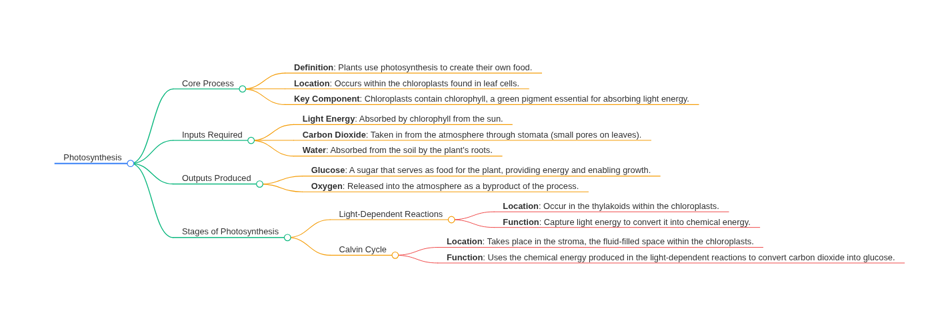
A MindLM mind map of a biology chapter: a fast way to list the concepts before linking them.
If you are mapping research papers, our guide to literature reviews with mind maps walks through a full workflow.
FAQ
What is the main difference between a concept map and a mind map?
A mind map branches out from one central topic into subtopics, with unlabeled lines meaning "part of". A concept map connects many concepts in a network, and every line has a linking phrase that states the relationship, such as "causes" or "requires". Mind maps organize information; concept maps explain how ideas relate to each other.
Is a concept map better than a mind map for studying?
It depends on the task. Mind maps are faster and better for note-taking, summarizing and reviewing a lot of material. Concept maps take longer but push you to explain relationships, which helps with subjects built on cause and effect, like biology or economics. Many students use both: a mind map to gather the material, a concept map to understand the connections.
Can a mind map have cross-links like a concept map?
Some people draw extra lines between branches of a mind map, and some software allows it, but it is not part of the classic format. Once you start adding labeled links between branches, you are effectively drawing a concept map. If relationships across the whole topic matter more than the outline, it is usually clearer to switch to a proper concept map.
Who invented concept maps and mind maps?
Concept maps were developed by Joseph Novak and his team at Cornell University in the 1970s, based on David Ausubel's learning theory. Mind maps were popularized by Tony Buzan in the same decade, through his books and TV work on learning techniques. Radial note-taking diagrams existed earlier, but Buzan gave the mind map its name and standard rules.
Does MindLM create concept maps?
No. MindLM generates mind maps: hierarchical diagrams with a central topic, branches and sub-branches. It does not support labeled links or cross-links, which concept maps require. You can use MindLM to pull the key concepts out of a long text or PDF, then use those concepts as the starting list for a concept map you draw elsewhere.
Pick the map that fits your question
In the concept map vs mind map choice, start with the question you are answering. Need to organize and summarize? Mind map. Need to explain how things connect? Concept map. For the first, MindLM can build the map from your material in a minute.
Related articles
- What Is a Double Bubble Map? Examples, Steps and Template IdeasA double bubble map compares two things: shared traits in the middle, differences on the outside. See examples, a step-by-step method and common mistakes.
- How to Turn a PDF into a Mind Map: Steps and a Paper ExampleTurn a PDF into an editable outline, check a real paper example against its source, then export Markdown for Obsidian. Manual and AI methods covered.
- Best AI Mind Map Generators in 2026 (Compared)Compare 7 AI mind map generators by free credits, PDF input, node editing, and Markdown export. Includes video limits, official sources, and a real paper example.