Mind map of Deep Residual Learning for Image Recognition
PDF · 12 pages · 67 nodes
What you add
1512.03385v1.pdf
PDF · 12 pages
12 pages · ~9,800 words becomes 67 nodes
Excerpt from the original: Deep Residual Learning for Image Recognition
Kaiming He Xiangyu Zhang Shaoqing Ren Jian Sun
Microsoft Research
{kahe, v-xiangz, v-shren, jiansun}@microsoft.com
Abstract
Deeper neural networks are more difficult to train. We
Interactive mind map
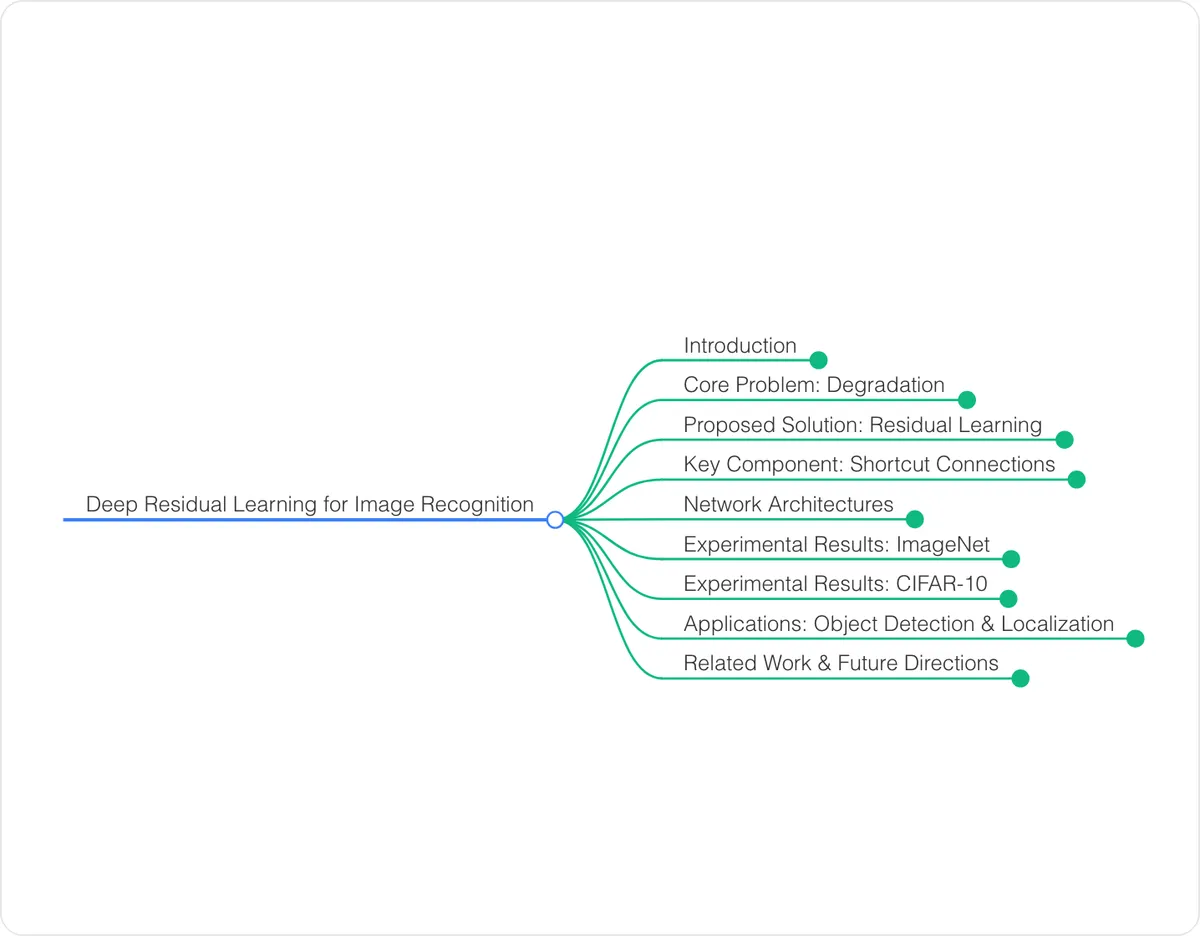 Loading the interactive mind map…
Drag to move, click a node to fold it.
Open in editorFree account
All 67 nodes
The full mind map as an outline.
Deep Residual Learning for Image Recognition
- Introduction
- Importance of network depth for visual recognition tasks
- Breakthroughs by deep convolutional neural networks
- Previous work on very deep models (VGG, GoogLeNet)
- Motivation: Can deeper networks always improve accuracy?
- Core Problem: Degradation
- Difficulty in training deeper networks
- Vanishing/exploding gradients (largely addressed)
- The degradation problem: Accuracy saturates and then degrades with increased depth
- Not due to overfitting; higher training error in deeper "plain" networks
- Implication: Current solvers struggle to optimize deep plain networks effectively
- Proposed Solution: Residual Learning
- Reformulating layers to learn residual functions F(x) := H(x) - x
- Original mapping H(x) becomes F(x) + x
- Hypothesis: Easier to learn residual mapping than original unreferenced mapping
- Extreme case: Identity mapping is optimal, residual function can be driven to zero
- Analogy: Preconditioning the problem, easier to learn perturbations around an identity
- Key Component: Shortcut Connections
- Realization of F(x) + x through shortcut connections
- Identity mapping shortcuts: add no parameters or computational complexity
- Element-wise addition of shortcut output and stacked layer output
- Flexibility: Can use linear projection (Ws) to match dimensions if needed
- Bottleneck architectures: Use 1x1 convolutions to reduce/restore dimensions for efficiency
- Parameter-free identity shortcuts are crucial for bottleneck designs
- Network Architectures
- Plain Networks: Inspired by VGG, with 3x3 convs, doubling filters with halved feature map size
- Residual Networks (ResNets): Inserting shortcut connections into plain networks
- Identity vs. Projection Shortcuts:
- Identity: Parameter-free, preferred when dimensions match
- Projection (Ws): Used to match dimensions, adds parameters and complexity
- Zero-padding: Option for dimension matching without extra parameters
- Bottleneck Designs: 1x1, 3x3, 1x1 convs for deeper networks (ResNet-50/101/152)
- Example Architectures: VGG-19, 34-layer plain, 34-layer residual
- Experimental Results: ImageNet
- Evaluation on ImageNet 2012 classification dataset
- Plain Networks: 18-layer and 34-layer show degradation (deeper has higher training error)
- Residual Networks (ResNets):
- 34-layer ResNet significantly outperforms 18-layer ResNet
- Addresses degradation problem, gains accuracy from increased depth
- Outperforms plain counterparts substantially
- Deeper ResNets (50, 101, 152 layers):
- Achieve state-of-the-art results
- 152-layer ResNet is the deepest network at the time, with lower complexity than VGG
- Ensemble achieves 3.57% top-5 error, winning ILSVRC 2015
- Identity vs. Projection Shortcuts: Minimal difference, identity is more economical
- Experimental Results: CIFAR-10
- Analysis on CIFAR-10 dataset with deeper networks
- Plain Nets: Exhibit degradation similar to ImageNet
- ResNets: Overcome optimization difficulty, gain accuracy with depth
- Explored up to 110 layers and 1202 layers
- 1202-layer network shows excellent training performance but worse test error (overfitting)
- Analysis of Layer Responses: ResNets show smaller response magnitudes, supporting residual function hypothesis
- Applications: Object Detection & Localization
- Good generalization to other recognition tasks
- Object Detection (PASCAL VOC, MS COCO):
- Replacing VGG-16 with ResNet-101 yields significant mAP improvements (e.g., 28% relative on COCO)
- Won 1st place in ILSVRC & COCO 2015 detection tasks
- ImageNet Localization:
- Novel per-class RPN and R-CNN framework
- Significantly reduced localization error compared to prior methods
- Won 1st place in ILSVRC 2015 localization task
- Related Work & Future Directions
- Residual Representations (VLAD, Fisher Vector)
- Shortcut Connections in prior work (MLPs, auxiliary classifiers, Highway Networks)
- Differences from Highway Networks (parameter-free vs. gated shortcuts)
- Future work: Exploring stronger regularization for extremely deep models, applicability to other domains